
Understanding 304, 316, Low-Carbon, and Super-Austenitic Stainless Grades
HGW Hydraulics on Aug 15th 2024
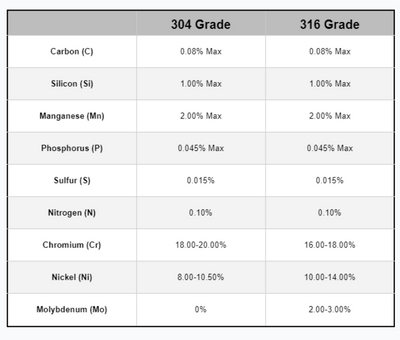
The 300 series contains austenitic chromium-nickel stainless steels used across fabricated equipment, tubing, fittings, food machinery, chemical systems, architecture, and general industry. 304 and 316 are the best-known grades, but their usefulness comes from alloy chemistry, processing, surface condition, and environment—not from a universal “surgical” or “marine” label.
Grade selection should identify the expected corrosion mechanism, fabrication route, mechanical requirements, and governing material specification.
Chromium forms the passive boundary
Stainless steel contains sufficient chromium to develop a thin chromium-rich oxide film in suitable oxidizing conditions. The film limits further reaction and can reform after minor surface damage when oxygen and chemistry permit.
The commonly cited stainless threshold is around 10.5 percent chromium by mass, although product specifications and grade definitions control exact composition. Surface contamination, scale, heat tint, deposits, and oxygen-depleted crevices can impair passivity.
Nickel helps stabilize the austenitic structure and supports formability and toughness. Other elements adjust corrosion, strength, machinability, or high-temperature behavior.
304 provides the general-purpose baseline
304 is often described as 18/8 stainless because typical compositions are associated with roughly 18 percent chromium and 8 percent nickel. It offers broad fabrication, forming, welding, and corrosion characteristics for compatible indoor, food-equipment, architectural, and industrial exposure.
It can pit and stain in chloride-rich or contaminated environments. Carbon-steel contact during fabrication can leave free iron that rusts on the surface. Cleaning and passivation may be specified after processing.
Exact mechanical properties vary with product form and condition. A sheet composition summary cannot establish the rating of a machined fitting or valve.
316 adds molybdenum for localized corrosion resistance
316 normally includes molybdenum in addition to chromium and nickel. This improves resistance to pitting and crevice corrosion in many chloride and process environments, supporting use in chemical, pharmaceutical, coastal, washdown, and marine-related equipment.
The improvement has limits. Warm chlorides, seawater immersion, deposits, crevices, acids, and stress can still attack 316. Concentration and temperature must be checked, and a higher alloy may be necessary.
Cost differences depend on alloy markets, product form, machining, availability, and quantity rather than one fixed premium.
The L suffix matters during welding
304L and 316L have lower maximum carbon than their standard counterparts. Lower carbon can reduce sensitization risk during welding, helping preserve corrosion resistance near heat-affected zones under applicable conditions.
Low-carbon grade does not eliminate the need for qualified welding, heat-tint removal, cleaning, passivation, filler selection, and inspection. Product specifications may permit dual certification where chemistry and properties meet both grade requirements.
Austenitic grades strengthen by cold work
Conventional 300-series austenitic stainless steels are not hardened by the same heat-treatment route used for martensitic grades. Cold working can increase strength and hardness while reducing ductility and changing magnetic response. Forming, bending, drawing, and machining history therefore affect the finished part.
They can be welded and formed readily compared with many higher-alloy materials, but work hardening and galling require suitable tools, speeds, lubrication, and process control.
Super-austenitic grades extend the chemistry
Super-austenitic stainless steels use higher combinations of nickel, chromium, molybdenum, nitrogen, and sometimes copper to address severe corrosion and maintain austenitic structure. They can offer substantially greater resistance to chloride pitting, crevice corrosion, or particular acids than 316.
They are not simply “better 316.” Fabrication, welding consumables, availability, thermal expansion, strength, code acceptance, and cost must be reviewed. Duplex, nickel alloy, titanium, or a nonmetallic material may be more appropriate in another service.
Choose the grade as part of the component
For fittings and valves, specify grade and material standard, manufacturing form, connection geometry, seal material, pressure-temperature requirement, surface condition, and documentation. Keep visually identical grades segregated and use traceable records or positive material identification where the risk requires it.
304, 316, their low-carbon variants, and super-austenitic grades form a progression of different capabilities, not a simple quality ladder. The correct choice is the least complex grade whose verified chemistry, fabrication, and corrosion behavior satisfy the actual environment.