
Troubleshoot Hydraulic Fittings with a Pressure-and-Failure Timeline
HGW Hydraulics on Jul 6th 2026
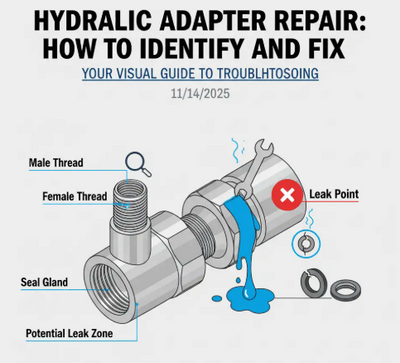
Advanced troubleshooting begins by establishing when a hydraulic connection changes from dry to leaking. Pressure, temperature, machine position and duty cycle create a timeline that often separates a damaged seal from surge, motion or material attack.
Changing the fitting before collecting that evidence can erase the cause and leave the replacement exposed to the same load.
Make leakage detection safe and repeatable
Isolate personnel from stored hydraulic energy and never use a hand to locate a suspected pinhole. Clean old residue, place observation controls and reproduce only the operating states authorized by the diagnostic procedure.
A compatible fluorescent dye can help trace small oil movement when the fluid and equipment maker allow it. Acoustic or ultrasonic instruments may detect escaping flow, but machinery noise, distance and sensor bandwidth can create false indications. Confirm a suspected location by another method before disassembly.
Record whether the leak appears during cold start, steady load, relief operation, actuator reversal, heat soak or shutdown. This timing is more useful than labeling every small leak a “micro leak.”
Trace oil back to the highest wet point and distinguish active seepage from fluid carried by airflow, gravity or a moving hose. On face-seal and flare connections, leakage may emerge around the nut even though the straight threads are intact. Temporary absorbent indicators or compatible developer materials may support observation only when the maintenance procedure permits them.
Document dye concentration, light source, instrument settings and background conditions. A tool becomes diagnostic evidence only when another technician can repeat the setup.
Capture transient pressure at the right location
A slow gauge may miss a short pressure spike. Select a transducer and data-acquisition rate suitable for the expected event, then install it at a diagnostic point that can see the circuit behavior in question.
Compare the trace with valve commands, actuator motion and load. Relief settings, load-induced pressure, rapid valve closure and hydraulic shock can produce different signatures. Verify the rated maximum of fittings, ports, hose or tube and instruments against credible transient conditions.
Closed-loop control can use pressure feedback, but a transducer alone does not prevent an overload. Control logic, sensor failure response and machine stability require system engineering.
Time-synchronize pressure data with valve current, position, temperature or machine command when those signals are available. A spike that follows actuator end-of-stroke needs a different investigation from one appearing during pump swashplate response. Check sensor range and mounting so the measurement device does not filter or create the event being studied.
Link contamination to physical evidence
Sample fluid using a controlled method and review particle type, concentration, water and wear trends. Inspect removed filters, seals and fitting faces. Hard particles can score O-rings and valve surfaces; fibers, seal fragments or corrosion products point to different sources.
Match filtration and breathers to the required cleanliness and environment. Increasing filter fineness without checking flow, cold viscosity and bypass behavior can introduce restriction.
Calculate movement before adding flexibility
Tube, hose and machine structures expand differently as temperature changes. Look for polished contact points, displaced clamps, bowed tube and fittings pulled out of square. Compare cold and hot positions through the actual operating range.
Change routing, loops, supports or flexible sections only through the design process. A generic metallic expansion joint may not be qualified for hydraulic impulse, movement direction or available space. Steam and exhaust piping rules should not be transferred to an oil circuit without engineering evidence.
Confirm when galvanic corrosion is plausible
Dissimilar metals require electrical contact and an electrolyte for galvanic corrosion. Map the materials, exposed area, moisture or chemical path and coating condition. An internal oil-wetted joint in a dry enclosure presents a different case from an outdoor salt-exposed adapter.
Isolation materials and coatings must tolerate pressure, temperature, motion and fluid. Selecting metals closer in a galvanic series can reduce driving potential in a stated electrolyte, but does not resolve crevice, pitting or general corrosion automatically.
Reconstruct assembly load and friction
Over-tightening can distort flares, expand ports, cut O-rings or raise thread stress. Under-tightening can leave inadequate clamp load. Check tool calibration, procedure, nut position, material, plating, lubricant and remake history.
Torque-angle or flats methods are useful only for connections whose instructions specify them. Lubrication changes the relation between torque and load; adding it without approval can worsen over-engagement.
Close the investigation with a tested cause
Retain failed components, photographs, pressure traces, fluid results and dimensional findings. State the most likely failure mechanism and what evidence would disprove it. Correct routing, pressure control, contamination entry, corrosion exposure or assembly practice before installing the final replacement.
Use comparison tests carefully. A new part that remains dry for one unloaded cycle has not disproved a temperature- or surge-dependent cause. Repeat the authorized load, speed and thermal conditions that defined the original timeline, while maintaining barriers and remote observation.
Update the machine history with the final seal compound, fitting identity, tightening method and relevant lot. If no cause is confirmed, record the uncertainty and monitoring trigger instead of inventing a confident root-cause label.
Verify the repair through the same operating timeline that revealed the leak. A fitting problem is solved when the symptom and the force that created it are both gone.