
Approve AN-to-JIC Substitution from Drawings, Not Dash Names
Mar 15th 2023
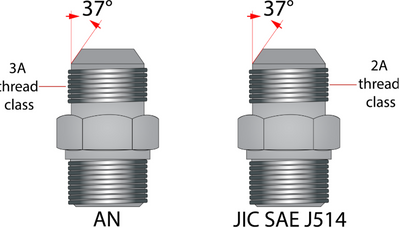
AN and JIC parts are often physically related through 37-degree flare geometry, but a maintenance substitution is not approved merely because both catalogs use a dash number. The replacement must match the mating interface and meet the technical and regulatory requirements of the equipment.
Decode the dash number correctly
In common 37-degree flare naming, a dash size is generally associated with tube outside diameter in sixteenths of an inch. For example, -8 corresponds to a nominal one-half-inch tube size and commonly uses a 3/4-16 straight thread at the flare connection. “3/4 JIC” can be ambiguous because it may be used informally for thread diameter or tube size.
Write the complete identification: dash or tube size, actual thread and pitch, male or female form, and 37-degree seat. Use the current drawing or dimensional table. Do not convert from a fraction or an inside-diameter measurement without knowing what the number describes.
Separate interface compatibility from product approval
AN originated in military and aviation hardware systems, while JIC terminology is widely used for industrial hydraulic 37-degree flare connections associated with SAE practice. Parts can differ in material, finish, dimensional tolerance, procurement specification, inspection, traceability, and qualification even when the joining geometry appears compatible.
An AN-marketed motorsport part is not automatically approved for an aircraft or industrial hydraulic circuit. Conversely, a standard hydraulic JIC fitting should not replace controlled aviation hardware without the responsible engineering and quality authorization.
Verify both sealing and retention
The 37-degree male cone and female flare must make full, clean contact. Confirm thread diameter, pitch, engagement length, seat dimensions, nut or sleeve geometry, and tube or hose end construction. The threads provide clamp load; the flare surfaces create the seal.
Inspect for radial scratches, dents, corrosion, bell-mouthed tube flares, and witness marks showing uneven contact. A fitting that screws together can still have a wrong seat, such as a 45-degree flare or a Japanese 30-degree style. Sealant on straight threads cannot repair the mismatch.
Check the rating of the proposed assembly
Pressure and temperature capability depend on size, material, wall or hose construction, fitting design, and manufacturer data. Compare fluid compatibility, corrosion environment, vibration, impulse duty, and the lowest-rated component. Do not carry a rating from one brand or material to another solely because both use a 37-degree interface.
For hose assemblies, the stem and ferrule must also be qualified for the hose. For tube assemblies, confirm tube material, outside diameter, wall, flare preparation, sleeve, and nut. Aircraft, vehicle, military, and regulated equipment may have additional approved-part and documentation controls.
Make the substitution traceable
Record the original part, proposed part, drawings or data reviewed, application, approving authority, and any limits. Keep AN and JIC descriptions distinct in inventory when their procurement requirements differ, even if a particular interface has been approved to mate.
If the information is incomplete, use the specified replacement instead of relying on appearance. A controlled substitution preserves the convenience of a common 37-degree connection while respecting the differences that matter beyond the threads.