
Stainless Tube Bending Methods: Controlling Flattening, Wrinkles, and Springback
Oct 19th 2022
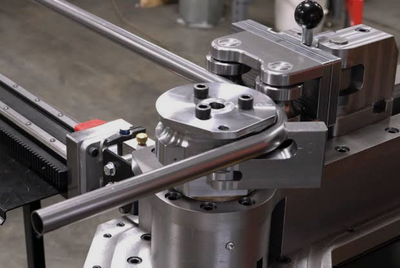
Bending stainless tube changes more than its direction. Material on the outside of the bend stretches and becomes thinner, material on the inside compresses and can wrinkle, and the cross-section tends to flatten. After the tooling releases, elastic recovery opens the angle through springback. A successful bend keeps those changes within the limits required by the assembly.
The method depends on tube outside diameter, wall thickness, alloy and condition, bend radius, angle, straight length between bends, appearance, flow requirement, and production volume. “Stainless steel” alone is not enough information to choose a bender or predict the final angle.
Define the bend before choosing the machine
Record centerline radius, bend angle, tangent locations, allowable ovality or flattening, wall-thinning limit, and orientation between multiple bends. Confirm whether the drawing dimensions refer to the tube centerline, outside surface, or endpoints. A 90-degree label without a radius and tangent definition is incomplete.
Tube ratio helps indicate difficulty. A large outside diameter with a thin wall is more likely to collapse or wrinkle. A tight centerline radius increases strain and tooling demand. Welded tube may require control of weld-seam orientation. Surface-finish requirements matter when clamp marks are unacceptable.
Material condition affects springback and formability. Two grades or heat lots can behave differently because of strength, work hardening, wall variation, and prior processing. Use verified material data and trial bends instead of assuming that one stainless grade is always easier to form than another.
Preparation protects both dimensions and cleanliness
Inspect the tube for dents, scratches, out-of-round ends, and contamination before bending. Cut to a controlled length and mark bend references using a method that will not damage the surface. Clean tooling prevents embedded carbon-steel contamination and visible marks on stainless.
Lubricant reduces friction at dies and internal tooling, but it must be compatible with the material, downstream cleaning, and final service. Process or instrumentation tube may require removal of lubricant and debris before assembly. Marking ink and adhesive residues can also matter in high-cleanliness applications.
Tooling should match the actual tube diameter and bend radius. An oversized groove allows flattening; an undersized or damaged groove can score the surface. Equipment capacity must cover the stainless alloy and section, not only a softer tube of the same size.
Rotary-draw bending controls a precise radius
Rotary-draw bending clamps the tube to a bend die and draws it around the die while a pressure die supports the straight section. It is widely used for repeatable elbows, frames, handrails, exhaust systems, and fluid lines where a defined radius and angle are required.
A wiper die can control wrinkles near the inside tangent. Clamp length and pressure-die action have to prevent slipping without crushing or marking the tube. Rotary draw equipment can be manual, hydraulic, electric, or CNC-controlled depending on size and production needs.
The method works well for multiple bends, but straight distance between bends must allow tooling to grip the part. Tool interference and bend sequence should be considered while the component is still being designed.
Mandrel support helps preserve the bore
Mandrel bending is a rotary-draw process with internal tooling placed near the bend tangent. A plug or ball mandrel supports the tube wall against collapse and can reduce flattening in thin-wall or tight-radius work. The number and position of balls, mandrel clearance, lubrication, and extraction timing affect the result.
Internal support is valuable where flow area, roundness, or appearance is important, such as exhaust, aerospace, automotive, process, and precision fluid lines. It adds setup and cleaning requirements. A poorly positioned mandrel can score the inside surface or become trapped.
Press and roll methods serve different geometries
Press bending pushes the tube against dies to create an angle. It can be practical for some structural work and less demanding bends, but it provides less support around the full bend than rotary-draw tooling. Flattening and local deformation should be evaluated when the tube bore or appearance matters.
Roll bending passes the tube through three or more rolls to create a large-radius curve. It is suited to arches, coils, rings, and sweeping structural or architectural shapes. The curvature develops gradually, so it is not the normal method for a compact elbow with a sharp tangent.
Multiple passes may be required to reach the final radius. End sections can remain less curved because they cannot stay engaged through the full roll geometry, so extra length and trimming may be planned.
Induction and CNC describe heat input and control
Induction bending locally heats a moving zone while the pipe or tube is formed around a controlled radius. It is used for large diameter or heavy-wall components in power, petrochemical, and pipeline-related service. Temperature control, cooling, material properties, wall thinning, and any required post-bend heat treatment are engineering issues, not shop improvisations with a torch.
CNC bending refers to programmed machine control rather than one fundamental deformation method. A CNC rotary-draw machine can coordinate feed, rotation, bend angle, tooling motion, and springback compensation to produce complex multi-bend parts repeatedly. The program still depends on correct tooling and validated material behavior.
Diagnose the defect from where it appears
Flattening or collapse points to insufficient internal or external support, an overly tight radius, thin wall, or incorrect tooling. Wrinkles on the inside radius can indicate compression instability, poor wiper or mandrel setup, or inadequate tension. Excessive outside-wall thinning can come from demanding geometry or tube movement through the dies.
Springback is expected in stainless. Controlled overbend can compensate, but the amount should be established through trials and measurement. Changing alloy lot, wall, tooling friction, or machine setup can change the compensation value.
Cracking calls for review of material condition, surface defects, bend radius, work hardening, and process path. A crack should not be polished away and accepted without evaluating the remaining wall and service requirement.
Measure, clean, and inspect the finished tube
Verify angle, radius, center-to-end dimensions, rotation between bends, ovality, and surface condition. For a hydraulic or instrumentation line, confirm that the bend has not restricted the bore or left debris that could enter the system. Cap clean ends during storage and transport.
Safe work also requires guarding, controlled clamping, appropriate eye and hand protection, and keeping personnel away from the sweep of the tube and moving dies. Manual force should never substitute for a machine that lacks capacity.
Good stainless tube bending comes from matching geometry to a process and then controlling the predictable failure modes. The bend itself is only one step; material identification, tooling, cleaning, measurement, and traceability determine whether the finished line belongs in service.