
Choosing Brass or Stainless Components for High-Pressure Hydraulic Service
HGW Hydraulics on Jul 23rd 2024
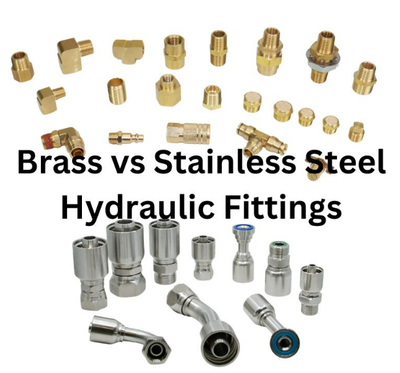
High-pressure hydraulic service cannot be assigned to a material name alone. Stainless steel often supports demanding component designs, while brass is used successfully in specific valves, instruments, and fittings. The allowable pressure comes from the exact product geometry, alloy, manufacturing method, size, temperature, seal, and test standard.
The first question is therefore not “which metal is stronger?” It is “which qualified component meets this pressure cycle and environment?”
Convert system pressure into a real duty definition
Record maximum working pressure, relief setting, transient spikes, impulse frequency, temperature, vacuum, and test pressure. Include vibration, hose movement, bending load, and the consequence of failure. A static gauge line and a mobile excavator circuit can share a peak number but impose very different fatigue conditions.
Use the lowest rating among the port, adapter, hose or tube, fitting, valve, and seals. Burst pressure is not working pressure, and a generic safety factor should not replace the governing standard and manufacturer’s data.
Compare materials within equivalent product forms
A stainless forged adapter should not be compared with a brass cast valve only by tensile strength. Match body form, connection, size, wall thickness, and manufacturing route. Confirm whether the published rating applies at the operating temperature and whether it changes for larger sizes or angled bodies.
Common austenitic stainless grades provide useful strength, toughness, and corrosion resistance. Brass grades offer machinability, ductility, and conductivity and may be appropriate where a validated brass component carries the required rating. Lead-content or dezincification requirements can limit the allowable brass grade.
Neither material is immune to fatigue, impact, or a stress concentration created by a poorly supported adapter.
Corrosion can reduce pressure margin over time
Stainless may pit in chloride exposure or corrode in crevices. Brass can dezincify or crack in particular water and chemical environments. External salt, cleaners, condensation, and dissimilar-metal contact can attack a fitting even when hydraulic oil is compatible internally.
Corrosion loss at a thread root or port boss changes the load-bearing section. Material selection must address the full exposure and inspection interval, not only the new-part rating.
For aggressive media, verify concentration and temperature against the exact alloy. “Stainless” and “brass” are incomplete purchase specifications.
Connection geometry often controls the failure
JIC seals at a 37-degree flare, ORFS at a face O-ring, ORB at a port O-ring, and NPT through a tapered threaded joint with the specified sealant. A correct high-pressure material with the wrong seat or thread remains a wrong fitting.
Stainless threads can gall under excessive friction. Brass threads and seats can deform under too much torque. Use approved lubricants or sealants and the product-specific tightening method. Do not add torque to compensate for a leak whose real cause is misalignment, an incorrect seal, or damaged surface.
Hose and tube routing should keep bending and vibration out of the port. A heavy adapter stack increases leverage and can fatigue either material.
Temperature and fluid affect seals as well as bodies
High fluid temperature can lower material allowable stress and harden or soften elastomers. Cold conditions can change seal flexibility and assembly response. Check O-ring, backup ring, hose, thread compound, plating, and valve seat along with the metal.
Aggressive fluids may attack a seal before they attack brass or stainless. Compatibility data and equipment requirements need to cover every wetted component.
Make an auditable selection
Specify product standard and part number, alloy grade, pressure and temperature rating, connection ends, seal compound, body shape, media, impulse or cycle requirement, and required documentation. Review certifications only against a defined need; a material report does not prove assembled pressure performance.
At receiving, verify markings, geometry, seals, and condition. After installation, pressure-test safely under the system procedure and inspect through the relevant operating cycle.
Stainless is often chosen for high-pressure hydraulic components because suitable products combine strength and corrosion resistance. Brass remains valid where an exact rated component and compatible environment support it. The decision rests on verified product performance, not a blanket rule that one metal is always high pressure and the other is not.