
Separate BSPP Retaining Threads from BSPT Thread Seals
HGW Hydraulics on Mar 8th 2022
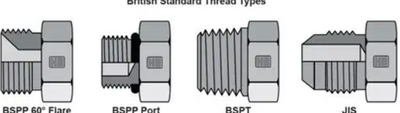
British Standard Pipe covers parallel and tapered thread forms that can share a nominal pipe size while sealing in different locations. BSPP usually retains a separate seat or seal; BSPT develops its pressure boundary in the tapered thread joint under the specified sealing practice.
Confusing the retention thread with the seal is more dangerous than confusing the abbreviations.
Read G and R as starting clues
G designations are associated with parallel pipe threads. R-family designations identify tapered external pipe threads, with related letters used for corresponding internal forms under the governing standard.
The letter and fractional nominal size should be confirmed with actual diameter, pitch, taper and component geometry. Nominal pipe size is not a direct measurement across the male thread.
Locate the BSPP sealing surface
A BSPP male can appear as a stud end sealing through an O-ring, bonded washer or soft sealing element against a machined port face. A BSPP swivel arrangement may seal at a 30-degree cone.
These configurations use parallel threads for clamping. Applying tapered-pipe sealant to the threads does not replace a missing washer, wrong O-ring or damaged cone.
Inspect the female half because the seat can be recessed. Measure the thread and the sealing feature before calling a connection simply “BSP parallel.”
Identify BSPT from taper and engagement
BSPT uses the 55-degree Whitworth thread form and a defined taper. Correctly matched components rely on thread engagement and appropriate sealant practice for the fluid and equipment.
Some documented arrangements may pair a tapered external thread with a compatible parallel internal pipe thread, but that is not permission to mix any BSPT male with any BSPP port. Port material, thread standard, engagement and manufacturer instruction still control.
Keep NPT and NPSM out of the joint
NPT and NPSM use a 60-degree thread form with different geometry. A near pitch can let a British part start into a U.S. pipe thread, creating false confidence and a possible helical leak path.
Use pitch gauges and dimensional tables; never force a candidate to prove identity. If threads bind unexpectedly during hand engagement, stop and remeasure.
Do not extend thread assumptions to flanges
Equipment using BSP threads may also use four-bolt hydraulic flange patterns comparable with SAE or ISO families. That is a separate connection decision. A British thread identity does not establish the flange series, O-ring or bolt pattern elsewhere on the machine.
For replacement, state BSPP or BSPT, nominal size, measured pitch, gender, seal location, body shape and the opposite adapter end. This description tells the installer why the thread is present and what actually contains pressure.