
Verify British, German, and Japanese Hydraulic Seats Beyond the Thread
HGW Hydraulics on May 12th 2021
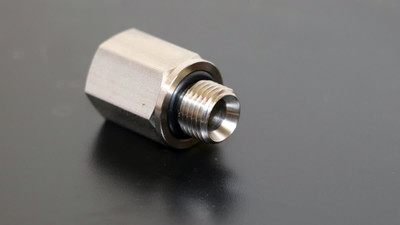
British, German and Japanese hydraulic connections often reach a U.S. repair bench after years of adapters and equipment modifications. Country of origin helps narrow the search, but measurement of thread, seat, seal and flange pattern decides the replacement.
Separate BSP taper from BSP parallel ports
BSPT uses a tapered pipe thread, commonly with a 55-degree profile. It develops thread interference and follows the specified sealant practice. NPT also tapers but normally uses a 60-degree form and different pitch relationships; close appearance does not make a valid pair.
BSPP is parallel. Hydraulic BSPP arrangements seal through a cone, bonded washer, O-ring, captive seal or another defined face. G and R designations can help identify parallel and tapered pipe families, but the actual port form must still be inspected.
NPSM and BSPP swivels are not interchangeable from parallel thread appearance. Measure pitch and mating seat.
Identify the German cone and tube system
German and European equipment may use 24-degree tube connections, 60-degree cone arrangements or metric port forms. Legacy DIN references and current ISO-related systems can overlap in field language, so request a drawing or full form designation.
A 24-degree body may mate with a tube, nut and cutting ring, a flareless swivel or a DKO-style O-ring nose depending on design. Tube OD and light/heavy series are part of the connection. A 60-degree cone requires its corresponding female nose.
DIN 3852-type port references include multiple sealing forms. Metric diameter and pitch alone do not reveal whether an O-ring, metal edge or washer creates the boundary.
Light and heavy tube-series labels also matter. A nut that turns onto a male thread does not prove that its tube OD, cutting ring, cone or working envelope belongs to the same series. Keep the body, tube, ring or sleeve and nut identified as one engineered assembly.
Treat JIS pipe similarity as a verification clue
Japanese tapered and parallel pipe forms can resemble BSP families and may share historical thread origins. Do not state that all JIS PT/BSPT or JIS parallel/BSPP components are universally interchangeable. Revision, tolerance, seat and equipment specification still control.
JIS 30-degree seats are distinct from SAE or JIC 37-degree flares. Threads can engage while the cones touch at an edge, producing a temporary seal and eventual damage.
Measure Japanese flange patterns independently
Japanese equipment may use four-bolt flange styles compared in field language with Code 61 or Code 62, as well as square-pattern flanges. Head diameter, bolt spacing, port, O-ring and pressure class must come from the actual standard or OEM data.
Do not replace a flange because the bolt holes can be forced into alignment. Clamp geometry and head thickness affect both seal compression and bolt load.
Separate a port form from a swivel connection
A drawing may use the same general thread family on a fixed port and a rotating female connector, yet place the seal in different locations. A bonded washer under a stud, an O-ring on a nose and a metal cone in a swivel are not interchangeable sealing strategies.
Before ordering, determine whether the observed male is a port adapter, hose end, tube fitting or flange head. Then inspect the female half. This prevents a common repair error: measuring only the exposed thread while the damaged or missing mating seat remains inside the equipment.
Use a controlled comparison when equipment history is unclear
Depressurize and clean the connection before inspection. Use thread gauges, calipers and seat-angle tools without forcing a candidate part into the port. Compare measurements to current dimensional references for the suspected standard and revision.
If earlier repairs added conversion adapters, work from the equipment port outward and record every transition. A Japanese machine may now carry a BSP or JIC hose end because an adapter was installed years ago; the visible hose does not redefine the original port.
Photographs should show the full body and a close view of the sealing face beside a scale. Record equipment model and location, because two similar ports on one machine can serve different functions or follow different standards.
Create an identification set from both mating halves
Record outside diameter, pitch, 55- or 60-degree thread profile where relevant, taper, cone angle, washer or O-ring, tube size and body shape. Photograph port cross-section and equipment location. For flanges, add pattern and head measurements.
British, German and Japanese labels organize standards; they do not authorize conversion. A verified adapter must reproduce the original seal on each end without using distortion as compatibility.