
Why a BSP Thread Name Cannot Supply an Adapter Pressure Rating
HGW Hydraulics on Feb 27th 2025
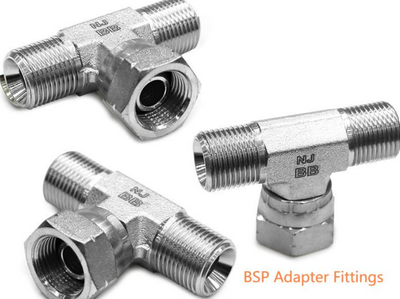
BSP describes thread geometry, not a universal pressure class. A G-thread bonded-seal adapter, an R-thread steel elbow, a plastic BSP fitting, and a bronze valve can share a nominal thread family while having very different allowable service conditions.
Pressure selection therefore starts with the exact component and its governing product data. Thread standard, size, body geometry, material, manufacturing route, seal, temperature, media, and test basis all contribute.
Separate thread dimensions from component performance
ISO 228-1 defines parallel G threads where the pressure-tight joint is not made on the thread. ISO 7-1 defines pipe-thread arrangements where sealing can occur through tapered engagement. Neither standard alone assigns the working pressure of every fitting made with those threads.
A straight union can carry load differently from an elbow or tee. Cast, forged, bar-stock, molded, and fabricated bodies do not share one wall or material condition. Larger sizes may have lower published pressure than small sizes in the same product family.
Use the manufacturer’s current table for the exact part and apply temperature derating, fluid compatibility, and the lowest rating in the connected assembly.
Proof pressure is not working pressure
Proof, burst, impulse, leakage, and working-pressure values answer different questions. A proof test demonstrates a specified temporary condition; it does not authorize continuous operation at that number. Burst results cannot be used as a normal limit.
Confirm test medium, duration, sample state, acceptance criterion, and applicable standard. Pressure cycling and vibration can govern a hose connection even when a static body test passes.
Avoid copying a promotional pressure from one material or size to another visually similar adapter.
Specialty retention changes the product definition
Thrust-wire fittings use a separate wire or retaining element in the connection. Where such a design is specified for severe pressure or vibration, wire material, groove, insertion, retention after assembly, local hardening, and inspection form part of the rated product. An ejected retainer can create a dangerous separation, so the manufacturer’s assembly procedure is essential.
Banjo fittings route fluid through a hollow bolt and an eye body, allowing orientation without rotating the attached line. Bore cross-holes, washers, bolt material, port face, and tightening load affect capability. Banjo is a geometry, not a low-pressure guarantee or limitation.
37-degree and face-seal ends use other rating systems
JIC industrial fittings seal at a 37-degree flare under SAE J514 requirements. AN fittings may share a 37-degree geometry but belong to aerospace specifications and controlled applications; industrial JIC should not be substituted for an aerospace part based on angle alone.
ORFS under SAE J1453 seals with an O-ring on a flat face. Seal compound, groove, tube or hose interface, and size influence performance. ORFS is not a blanket “drop-in upgrade” for a JIC line; a designed adapter or changed tube end is required.
These families often appear on the opposite side of a BSP adapter. Each end keeps its own sealing method and rating constraints.
Material choice follows the fluid and environment
Carbon steel, stainless steel, brass, bronze, cast iron, PTFE, PVC, nylon, and other materials can be supplied with BSP-style threads in suitable products. Their corrosion, strength, temperature, creep, impact, and code behavior differ.
Stainless may gall at threads and can pit in chlorides. Plastics can lose strength with temperature and sustained load. Brass composition may be restricted by potable-water or dezincification requirements. Verify exact grade, not the broad material name.
Build an auditable pressure selection
Record part number and revision, full end descriptions, nominal size, body form, material, seal, maximum working and transient pressure, temperature range, media, external environment, vibration, and applicable testing. Confirm whether pressure acts internally, externally, or in both directions.
At receiving, inspect markings, threads, sealing faces, O-rings or washers, and any retaining wire. During installation, support the line and follow specified torque or turn procedure. Pressure-test under a safe approved process.
A BSP label makes parts dimensionally searchable. It does not make them pressure-equivalent. Treating rating as a property of the complete, documented component prevents a thread name from becoming an unsafe design shortcut.