
BSP Fitting Identification for Global Hydraulic Equipment
HGW Hydraulics on Apr 3rd 2025
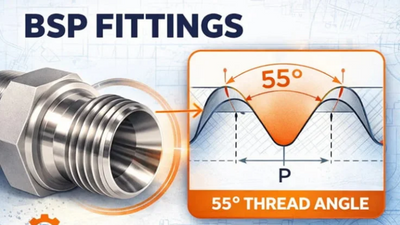
BSP fittings appear on European, Asian, Australian, African, Middle Eastern, and globally supplied machinery. The family includes parallel and tapered threads, several sealing arrangements, many body shapes, and materials ranging from carbon steel and stainless to brass and polymers.
A useful identification process narrows that variety in a fixed order: equipment context, male/female end, parallel or taper, pitch and size, seal location, body configuration, and service conditions.
Equipment context creates candidates
Record machine manufacturer, model, component, port location, and the circuit function. A pressure gauge connection, hose swivel, manifold port, pump adapter, and process pipe may use different BSP arrangements even at the same nominal size.
Country of manufacture is only a clue. OEMs source valves and instruments internationally, and field repairs may have added adapters. The installed geometry and documentation control.
Split parallel from tapered before measuring size
BSP uses a 55-degree Whitworth thread profile. BSPP/G stays parallel. BSPT/R-family threads use taper for pressure-tight thread joints. Measure diameter at two locations and verify pitch with a BSP gauge.
G threads follow ISO 228-1 and need a seal outside the thread. R, Rc, and Rp follow ISO 7-1 joint concepts. Do not group a G female and Rp female merely because both appear straight; their tolerances and intended mates differ.
Rule out NPT’s 60-degree form. Several sizes are close enough to begin engaging, which can damage the only sample.
Locate the sealing surface
A parallel male adapter may compress a bonded washer against a port spotface, carry an O-ring near its shoulder, or mate through a cone or metal face. A pressure gauge can use a washer at a defined bore or shoulder. A hose swivel can contain its own seat.
A tapered R connection relies on thread engagement and the specified jointing material. Sealant should be compatible with fluid and temperature and applied without contaminating the passage.
Photograph the disconnected port and fitting separately. A washer hidden under the hex or a cone inside a nut often provides the strongest identification evidence.
Convert nominal size carefully
BSP nominal fractions come from pipe conventions and are not actual outside diameters. Combine caliper measurement with threads per inch and a current standard chart. Check engagement length and external Class A/B callout for G threads where specified.
Do not infer size from wrench flats, hose ID, or a metric ruler reading. On reducers, each end needs its own definition.
Body shape affects installation
Straight, elbow, tee, cross, bulkhead, swivel, banjo, reducer, plug, and flange adapters change routing and load. Confirm whether a swivel rotates only for assembly or is intended for live motion. Verify elbow orientation and available wrench clearance.
Support hose and tube so the fitting is not a cantilever. A correct thread can still fail when a heavy adapter stack vibrates at the port.
Material and rating are separate checks
Carbon steel, stainless steel, brass, malleable iron, bronze, and polymers have different corrosion, temperature, creep, galling, and pressure behavior. The exact component rating—not the BSP family—sets the allowable service.
Specify media, external environment, temperature, maximum and transient pressure, and documentation. Include O-ring or washer compound. Coating can affect thread gauging and corrosion life.
Create a repeatable replacement record
The final record should include full thread designation, nominal size, gender, seal type, body shape, material, opposite end, equipment location, photos, measured OD and pitch, and original part number. Store confirmed look-alikes separately.
Use a designed transition adapter when connecting BSP to JIC, ORFS, ORB, NPT, metric, or another system. Each side must keep its intended seal.
BSP sourcing becomes manageable when the family is treated as a sequence of observable decisions rather than one thread label. That record also turns the next replacement from a field mystery into a controlled repeat order.