
Separate BSPP, BSPT, NPT, and NPTF by Thread Form and Seal
HGW Hydraulics on Jan 19th 2022
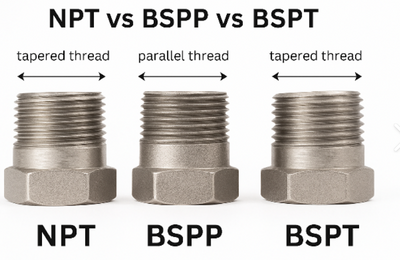
BSP and NPT parts can share a nominal pipe-size name and still have different diameter, pitch, thread angle, taper, and seal. A near-match that turns several times is not evidence of compatibility.
BSPP needs a separate sealing feature
BSPP uses a 55-degree Whitworth parallel thread. The thread usually retains the joint while a 60-degree cone, bonded washer, O-ring, copper washer, or another defined face seals. Identify the exact port or swivel; generic thread sealant does not turn every BSPP end into a pressure joint.
“G” commonly denotes BSPP. Measure major diameter and threads per inch, then inspect the seat, shoulder, and spotface.
BSPT seals through tapered engagement
BSPT also uses a 55-degree Whitworth form, but its diameter changes along the thread. It is commonly designated with “R” family notation. The compatible male/female arrangement and sealant practice come from the applicable standard and component instruction.
A bonded washer is generally associated with a face/port seal, not a universal BSPT sealing method. Do not force a tapered male into an arbitrary BSPP swivel because both are called BSP.
NPT uses a different 60-degree form
NPT is tapered and uses a 60-degree thread form with its own diameters and pitches. It commonly needs an approved sealant to control the helical leakage path. BSP and NPT are not interchangeable even when their measured diameters look close.
NPTF dryseal geometry is related but controlled differently at crests and roots. It should not be described as automatically sealant-free in every component, material, or service; follow the manufacturer and governing specification.
Nominal size is not caliper diameter
Clean the part, determine parallel versus tapered, measure at defined positions, use a pitch gauge, and compare the raw values with a current chart. Identify the seal and the opposite adapter end. Do not classify by country alone: imported and North American equipment can contain several standards.
Assembly condition matters
Inspect damaged lead threads, old compound, corrosion, and port cracks. Use only compatible sealant in the specified location and engagement method. Excess tape or paste can enter the hydraulic circuit.
Record thread family, nominal size, pitch, male/female, seal, material, rating, and approved replacement. BSPP, BSPT, NPT, and NPTF become manageable when thread geometry and seal are documented separately.
Inspect common failure evidence
A BSPP washer leak can come from a scratched spotface, damaged washer, wrong thread length, or a body that bottoms before compression. A cone swivel can leak from a mismatched angle or scored seat. Adding tape to the parallel thread does not correct either condition.
A tapered joint that repeatedly leaks may have damaged flanks, insufficient engagement, wrong thread family, incompatible sealant, or a cracked female port. Preserve the old parts before adding torque.
Compare complete adapter ends
BSP and NPT adapters often convert to JIC, ORFS, ORB, metric, tube, or hose interfaces. Identify the second end and minimum passage independently. An adapter with correct pipe thread can still have the wrong flare or O-ring seal.
Keep similar 1/4, 3/8, and 1/2 nominal sizes separated in stock and label actual thread plus seal style. Use verified gauges and drawings rather than test-fitting into the machine.
Consider service and material together
Brass, coated carbon steel, stainless steel, and other alloys have component-specific pressure, temperature, corrosion, and galling behavior. Shipboard, oil and gas, manufacturing, and chemical systems can use either BSP or NPT depending on the design; industry name does not select the thread.
After controlled assembly, verify leakage at operating temperature and pressure. Update the equipment record so the next replacement retains thread, seal, sealant, material, and orientation.