
Assembling BSP Parallel and BSP Tapered Connections by Seal Location
HGW Hydraulics on Mar 4th 2025
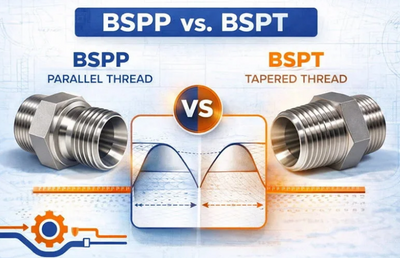
BSP parallel and BSP tapered threads share a 55-degree Whitworth profile, but their finished joints contain fluid in different places. A BSPP or G-thread hydraulic port normally seals at a shoulder, washer, O-ring, cone, or other defined face. A BSPT or R-family tapered joint seals through controlled thread engagement under the specified sealing practice.
Assembly should follow that fluid boundary. Applying the procedure for one type to the other can damage a port while leaving the real seal untouched.
A G thread supplies axial clamping force
ISO 228-1 G threads remain parallel along their length. A male stud can tighten a bonded washer between its shoulder and the port spotface. Other designs use an O-ring, metal washer, pressure-gauge seal, or cone arrangement.
The thread holds the parts together but is not intended to become pressure-tight through wedging. Inspect the port face for radial scratches, dents, paint, corrosion, and tool marks. Replace the sealing element with the specified size and material.
Start the thread by hand and keep the washer centered. Tighten using the component procedure. Pipe tape on the G thread does not repair a damaged spotface and can enter the system.
An R thread increases interference with depth
ISO 7-1 tapered male R threads reduce in diameter toward the end. Compatible female arrangements include tapered Rc or parallel Rp threads as defined by the standard and product design. Tightening creates radial contact along the threaded region.
Use only the sealant or lubricant approved for the media, material, temperature, and connection. Keep it away from the first thread and passage where instructed. Start by hand to detect pitch mismatch or cross-threading.
Overtightening can expand or crack a female port, especially in thin or brittle bodies. Backing off an elbow for orientation can disturb the seal.
Spotface and tapered thread are not the same feature
Some source descriptions confuse BSPT with fittings that use a machined spotface and bonded seal. A spotface is characteristic of many parallel-stud sealing arrangements. A tapered thread normally relies on its documented thread joint, not an added washer chosen at random.
Always inspect the actual fitting drawing. Specialized designs can combine features, but their compatibility must be explicit.
Identify before choosing tools or compound
Measure thread diameter at two axial positions. A constant diameter suggests BSPP; a measurable change suggests BSPT. Confirm pitch and 55-degree profile with suitable gauges and compare with a current table.
Nominal BSP fraction does not equal measured outside diameter. Rule out NPT, which uses a 60-degree form and different pitch/diameter combinations. A false fit can bind after several turns and should not be forced.
Check markings: G commonly indicates parallel; R indicates tapered external; Rc tapered internal; Rp parallel internal intended for an ISO 7-1 pressure-tight thread joint. Marking and geometry should agree.
Troubleshoot at the designed seal
A G-port leak calls for inspection of the bonded washer or O-ring, spotface, shoulder, alignment, and stud-end type. A tapered leak calls for checking thread match, engagement, sealant, galling, cracking, and prior damage.
Do not add torque first. Depressurize safely, clean the area, verify the leak origin, and examine witness evidence. Fluid can travel from another connection and collect at the BSP joint.
Keep replacement identity complete
Record full designation, size, gender, seal type, body shape, material, opposite connection, media, temperature, and equipment location. If an adapter transitions to JIC, ORFS, ORB, NPT, or metric, specify that second end independently.
BSPP and BSPT assemble reliably when parallel threads clamp a defined external seal and tapered threads are treated as a controlled pipe joint. Remembering the seal location is more useful than remembering which style is more common in a region.