
Reading G, R, Rc, and Rp Pipe Thread Callouts Correctly
HGW Hydraulics on Mar 25th 2025
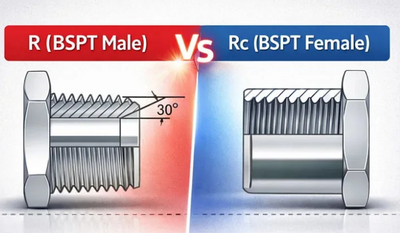
Terms such as BSPP and BSPT are useful shop language, but engineering drawings often use G, R, Rc, and Rp. Those letters identify not only parallel or tapered geometry but also which standard and pressure-joint concept applies.
The key distinction is that ISO 228-1 G threads are fastening threads whose pressure seal occurs outside the thread. ISO 7-1 R-family threads are intended for pressure-tight joints made on the threads.
G identifies an ISO 228-1 parallel thread
Both male and female G threads are parallel and use the 55-degree Whitworth form. The male external thread can have tolerance Class A or B; the internal thread has one class without an A/B suffix.
In a hydraulic port, the G thread may clamp a bonded seal, O-ring, washer, metal face, or type-specific stud end. The part drawing must define that feature. Two G threads can engage mechanically while lacking a complete pressure seal if the faces do not match.
Do not apply tapered pipe-thread installation rules to G threads. Thread tape cannot create the missing shoulder or cone.
R means an external tapered thread
An R male follows ISO 7-1 taper and 55-degree thread form. Its diameter changes at 1:16 on diameter. It is used in a pressure-tight thread-joint arrangement with the defined female counterpart and suitable jointing practice.
Sealant requirements depend on media, material, component instructions, and code. Tightening produces radial load, so excessive engagement can damage the female part.
Rc and Rp distinguish two female counterparts
Rc designates an internal tapered thread under ISO 7-1. Rp designates an internal parallel thread intended for a pressure-tight joint on the threads with a compatible tapered R male.
Rp is not the same designation as a female G thread even though both are parallel and related to the Whitworth pipe family. Their tolerances and intended mating/joint context differ. Substitution requires product-standard confirmation.
A common safe reading pattern is R external with Rc internal, or R external with the specified Rp internal arrangement. The standard and component manufacturer define acceptable combinations and jointing materials.
BSPT is not a fourth geometry beside R and Rc
BSPT is the general commercial description for tapered British pipe threads. R and Rc are directional designations within the ISO 7-1 system: male taper and female taper. Treating BSPT, R, and Rc as unrelated families creates unnecessary confusion.
Likewise, BSPP commonly refers to G parallel threads, but a complete hydraulic connection still needs its sealing style and port standard.
Field identification must confirm four features
First, determine male or female. Second, measure whether diameter changes along the axis. Third, verify pitch and 55-degree profile. Fourth, locate the seal: thread joint, bonded washer, O-ring, cone, or face.
Use calipers and proper gauges, then check markings, equipment drawings, and the intended mate. Coating, wear, and short thread length can obscure taper. Nominal pipe size is not the measured OD.
NPT is not an alternative mate. Its 60-degree profile and different pitches prevent a controlled BSP seal even when the part starts to screw in.
Compatibility must include service conditions
After identifying geometry, verify material, pressure-temperature rating, media, sealant or elastomer, engagement length, and code requirements. A geometrically valid R/Rc pairing can still be unsuitable for the fluid or component rating.
For mixed equipment, use a purpose-designed adapter with a complete G or R-family end on one side and the correct JIC, ORFS, ORB, NPT, metric, or other end on the opposite side.
Write unambiguous purchase descriptions
Use full standard designation where available, nominal size, gender, external tolerance class for G where required, port/stud sealing type, body form, material, and opposite connection. Keep R, Rc, Rp, and G parts in labeled bins.
G, R, Rc, and Rp are not just alternate spellings for BSP. They show how a parallel or tapered part is intended to mate and where pressure containment occurs. Reading that logic prevents a mechanically engaging thread from being mistaken for a finished fluid connection.