
BSPP Class A and B Apply to External G Threads—not Two Male/Female Grades
HGW Hydraulics on Feb 13th 2025
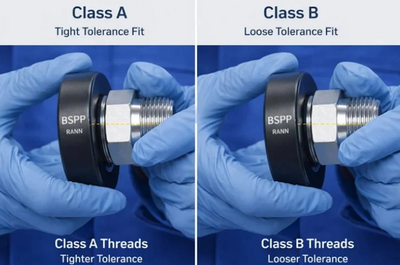
ISO 228-1 BSPP threads are parallel 55-degree Whitworth-form threads intended for mechanical assembly. When a pressure-tight connection is required, a washer, O-ring, gasket, cone, or other defined surface outside the thread creates the seal.
The tolerance notation is often described incorrectly. Under ISO 228-1, Class A and Class B are the two pitch-diameter tolerance classes for external G threads. Internal G threads have one tolerance class and do not receive an A or B suffix.
Designation shows which part owns the class
An internal right-hand thread is designated with G and its nominal size, such as G 1/2. An external thread can be designated G 1/2 A or G 1/2 B. A left-hand thread adds the specified LH notation.
This means “Class B internal thread” is not an ISO 228-1 designation. A drawing that uses that phrase should be clarified before production rather than silently interpreted.
ISO 228-1:2000 remains the reference for thread form, dimensions, tolerances, and designation; ISO 228-2 addresses verification and recommended gauging. Product standards can specify which external class applies.
Class A and B change external pitch-diameter tolerance
Both external classes have negative pitch-diameter deviations relative to the basic profile. Class A uses the narrower tolerance, equivalent in value to the respective internal-thread tolerance. Class B permits twice that pitch-diameter tolerance.
Class A is therefore tighter in this specific dimensional sense, but it is not a universal quality grade. Class B is an intentional standard class selected for application and product requirements. Neither class changes the 55-degree thread form, pitch, nominal size, or external seal design.
The internal thread has its own single positive tolerance zone. A usable fit comes from the combined limits of that internal G thread and the specified external class.
Thread class does not create hydraulic sealing
A closer external fit can affect alignment, play, assembly feel, and load distribution, but BSPP is not intended to become pressure-tight by wedging the thread. The actual hydraulic seal still depends on the port and stud-end design.
ISO 1179 parts define several fluid-power ports and stud ends using ISO 228-1 threads with elastomeric or metal-to-metal sealing. A bonded washer, port O-ring, or type-specific face must have correct dimensions, finish, compression, and material.
Adding tape to a G thread does not correct a missing or damaged face seal. Likewise, selecting Class A cannot repair a scratched spotface or wrong O-ring.
Inspection must use the specified gauge system
Thread pitch, major diameter, minor diameter, and pitch diameter are controlled differently. GO and NOT-GO limit gauges and other methods under the applicable gauging standard verify the required features. A nut that turns by hand is not an inspection result.
Gauge identity, wear, calibration status, temperature, cleanliness, coating thickness, and measurement procedure affect acceptance. Stainless parts also need galling control during test assembly; repeated use of a production counterpart as a gauge can damage both pieces.
For plated external threads, coating buildup must be accounted for by the drawing and manufacturing process. Do not recut a finished thread without reviewing corrosion protection.
Specify the complete port or connection
State ISO 228-1 designation and external class where applicable, nominal size, male/female end, port or stud-end standard, seal type and compound, spotface or cone requirements, material, finish, and inspection records. If a customer drawing conflicts with the standard, obtain written clarification.
At receiving, verify the actual seal as well as the thread. A correct G 1/2 A external thread on the wrong stud-end geometry will not make the required joint.
BSPP Class A and Class B are meaningful manufacturing choices, but only for external threads. Keeping that fact separate from the single internal class and from the hydraulic face seal prevents tolerance language from becoming a false explanation for leakage.