
BSPP and BSPT Connections: Same Pipe Family, Different Seal Locations
Jul 6th 2023
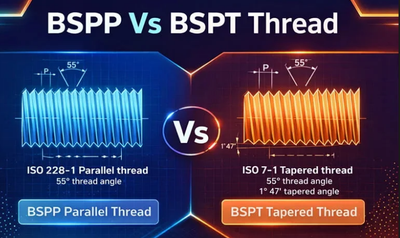
BSPP and BSPT share the British pipe-thread family and a 55-degree Whitworth form, but they do not create a seal in the same way. BSPP has parallel threads and normally relies on a washer, O-ring, cone, or face. BSPT uses tapered engagement and the specified thread-sealing practice.
That means an installer must identify more than nominal BSP size. The port shape and sealing component determine whether the connection is complete.
Read parallel and tapered ends differently
A BSPP male keeps essentially the same thread diameter along its working length. Tightening supplies axial clamping force without wedging the thread into a smaller female diameter. Common hydraulic port arrangements use a bonded seal under the fitting shoulder or another defined seal at the port face.
A BSPT male decreases in diameter along its length. As it enters a compatible tapered female, the flanks interfere. The applicable instructions may call for PTFE tape or a liquid compound suitable for the service.
Both types can carry “BSP” in a casual description, so that word alone is insufficient for ordering or inspection.
Standards and callouts provide the strongest evidence
ISO 228-1 addresses pressure-tight-joint-not-made-on-the-threads dimensional pipe threads, commonly associated with BSPP or G threads. ISO 7-1 covers pipe threads where pressure-tight joints are made on the threads and uses R-family designations for tapered and related mating threads.
A drawing can also define a cone-seat BSP swivel, a port O-ring arrangement, or a bonded-seal face. Read the complete end callout and referenced standard. Do not infer the seal from “G 1/2” without seeing how the component is designed to mate.
Nominal BSP fraction is inherited from pipe conventions and is not the measured outside diameter. BSPP and BSPT at the same nominal size share the same basic pitch family, so pitch does not separate them.
Identify an unknown BSP connection in four observations
First, measure diameter near the leading and rear threads. A meaningful change indicates taper; a constant value indicates parallel. Second, check pitch using a BSP gauge. Third, confirm the 55-degree profile where required. Fourth, inspect the sealing surface and the original mating part.
Calipers can screen a sample, but correct gauges and drawings are needed for controlled inspection. Coating, wear, thread damage, and limited measurement length can make a taper difficult to see.
Also rule out NPT. It uses a 60-degree profile and different pitch/diameter relationships. Some cross-standard combinations begin to turn and then bind, which is damage rather than compatibility.
Assembly should follow the fluid boundary
On a BSPP bonded-seal port, inspect the spotface and replace a damaged washer with the specified size and material. Keep the O-ring or elastomer centered during tightening. Tape on the straight thread does not repair a scratched spotface or a missing seal.
On BSPT, clean the threads, apply only an authorized sealant, start by hand, and follow the manufacturer’s tightening method. Do not copy an NPT turn count. Excess torque can distort a port, and backing off a tapered elbow for orientation may disturb the seal.
Stainless steel can gall in either thread type under high friction. Proper surface condition, approved lubrication or sealant, controlled alignment, and correct tools matter more than a blanket preference for parallel or tapered ends.
One type is not universally better
BSPP often offers repeatable service because its sealing element can be inspected and renewed without wedging the port. It is common on hydraulic manifolds, adapters, pneumatic equipment, instrumentation, and OEM machinery.
BSPT remains appropriate in piping and equipment designed for tapered pipe thread. Its performance comes from the exact components and assembly, not from a general low-pressure label. Codes may govern gas or other special service.
A BSPT male should not be forced into an arbitrary BSPP female. Certain standardized combinations within the broader pipe-thread system may exist, but they require documented compatibility and the correct sealing arrangement.
Specify what purchasing and receiving must preserve
Record BSPP or BSPT, complete thread callout, nominal size, male/female orientation, port seal type, body form, material, opposite connection, media, temperature, and application requirements. Photograph the shoulder and internal port, not just the threaded exterior.
For a transition to NPT, JIC, ORB, metric, or another standard, choose an adapter that states both ends. Verify the seal on each boundary and limit unnecessary stacked connections.
BSPP and BSPT are easy to distinguish once the inspection starts with taper and ends at the seal. That sequence is more reliable than judging the fitting by region, wrench size, or how far an unknown part can be turned.