
Decide Hydraulic Fitting Reuse from Component Function and Damage Evidence
HGW Hydraulics on Oct 17th 2023
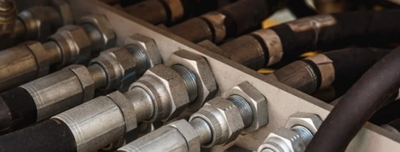
“Can this fitting be reused?” has no safe yes-or-no answer at the connection-family level. A detachable adapter body, a tube nut, a cutting ring and a crimped hose stem perform different functions and have different remake rules.
Reuse requires product authorization and evidence that the component still meets its purpose.
Classify the part before inspecting it
A threaded adapter or removable ORFS, ORB, JIC or BSP body may be serviceable after inspection when its specification permits. A crimped hose coupling normally belongs to the hose assembly and should not be cut off and installed on new hose. Welded and permanently formed ends are not detachable reusable fittings.
Some ferrules, cutting rings, tube sleeves and locknuts have limited remake rules. Keep them with their original tube or replace them as the system instructions require.
NPT threads deform as they engage and may accumulate sealant or damage; do not assume all pipe fittings are designed for unlimited reuse.
Preserve failure evidence during removal
Depressurize and make the equipment safe, then mark orientation and identify the leak location before cleaning. Oil at the fitting may have traveled from a hose crimp, tube crack or adjacent port.
Use backup wrenches so removal does not twist tube or load the machine port. If a fitting was subjected to fire, severe overpressure, impact or an unknown failure, replacement is the conservative choice even when visual damage is limited.
Inspect the metal pressure surfaces
Clean by an approved method and inspect threads, wrench flats, body, flare cone, face, groove and port stud. Reject cracks, yielding, corrosion loss, galling, crossed or stretched threads, scoring across a seat and deformation from overtightening.
Dimensional gauges can support thread and seat checks. A known mating part should not be forced into the fitting as a test.
Adjustable adapters need inspection of locknut, backup washer and orientation mechanism as well as the stud end.
Renew seals under the product procedure
O-rings and soft seals can take compression set, swell, harden or suffer small cuts. Replace them when the applicable maintenance instruction calls for it, using the exact size and compatible compound.
Do not add tape or sealant to ORFS, ORB or flare faces. For tapered pipe threads, remove old material without damaging the thread and apply only the approved sealant on reassembly.
Reassemble as a controlled connection
Confirm part identity, rating, material and both mating interfaces. Align without side load and use the specified lubrication condition and tightening method.
After safe pressure restoration, inspect from outside the spray path. Record the reused component and reason for acceptance when failure consequence or traceability requires it.
Reuse is economical only when inspection and product rules support it. Unknown history, damaged sealing geometry or a permanently attached end is a replacement decision, not an opportunity to save a fitting.