
Choose Fitting Alloy from the Pressure Boundary and Exposure Zone
HGW Hydraulics on Apr 17th 2024
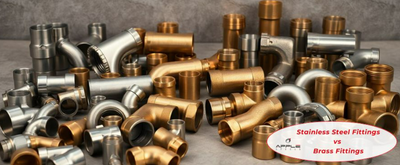
Carbon steel, stainless steel and brass each cover broad alloy and product families. Material selection should begin with the pressure boundary and exposure zones, then use the rating and connection data for the exact fitting.
Generic pressure ceilings or application lists create false confidence because geometry and size can change capability more than the material name.
Use carbon steel where strength and protection align
Carbon steel supports many hydraulic adapters and hose fittings on construction, agricultural and industrial equipment. Forging, bar machining, heat treatment and design can provide useful strength and toughness.
It is not automatically too brittle for crimping. Hose stems and ferrules are engineered from specific steels and processes for controlled deformation. Conversely, a random carbon-steel fitting should not be crimped unless it belongs to the qualified hose system.
External corrosion resistance often depends on plating or another finish. Evaluate coating damage, salt, humidity, washdown and the system's restriction on substances such as cadmium.
Select stainless by grade and fabrication
Stainless steel can reduce corrosion and contamination in chemical, marine, food, medical and instrumentation environments. The exact grade, heat treatment, surface condition and fabrication determine its behavior.
Stainless is not automatically qualified for higher pressure than carbon steel. Check product rating, tube or hose attachment, thread or seat, temperature and possible galling during assembly.
Cleaning and passivation may be required where free iron contamination or process cleanliness matters. Those treatments do not make an unsuitable grade immune to chlorides or acids.
Use brass for its specific fluid and forming advantages
Brass is machinable and can serve water, pneumatic, instrumentation and selected hydraulic duties. Alloy composition affects strength, ductility, lead content, dezincification and chemical resistance.
Do not apply one 3,000-psi or 400-degree-Fahrenheit limit to every brass fitting. Use finished-product data and account for the seal and attached tube.
Brass is not a universal choice for highly corrosive media. Ammonia, some waters and other chemicals can attack particular alloys.
Check mixed-material boundaries
When a fitting connects to a different metal, evaluate galvanic contact, electrolyte, area ratio and external exposure. A stainless body, carbon-steel port and brass adapter can create more than one corrosion zone.
Seals, thread compounds and tube materials must also be compatible with the fluid and temperature. A corrosion-resistant body cannot repair an incompatible elastomer.
Write the material requirement completely
Specify alloy or governing material standard, product form when important, finish or passivation, connection standard, size, pressure/temperature rating and required documentation. Include cleaning and traceability for critical process use.
The correct alloy is the one whose finished connection survives the actual mechanical and chemical environment. “Stronger,” “stainless” or “lower pressure brass” is not enough to place an order.