
Read Fitting Alloy Names as Compositions, Conditions, and Processes
HGW Hydraulics on Aug 27th 2025
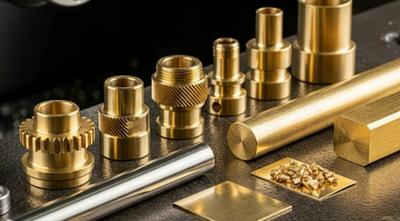
Brass, carbon steel and alloy steel describe different material families. Their useful properties come from controlled composition, processing and final condition; manufacturers do not simply add one element to a generic steel and receive a guaranteed result.
For a hydraulic fitting, material identification must be tied to the product geometry, manufacturing route, heat treatment and applicable specification.
Brass is a copper alloy, not an alloy steel
Brasses contain copper and zinc, often with other controlled additions. Changes in composition affect machinability, strength, formability, conductivity and corrosion behavior. That variety supports machined adapters, tube fittings, flare components and many water or pneumatic products.
Corrosion performance is media-specific. Some brass alloys can suffer dezincification in certain waters, and lead-content or product-listing rules may apply to potable systems. Do not infer hydraulic pressure or drinking-water acceptance from the word brass.
Carbon steel is a broad fitting base material
Carbon and manganese content, cleanliness, grain structure, cold work and heat treatment influence steel strength and toughness. Machined bar, forging and tube each produce different geometry and property considerations.
Carbon-steel fittings are common in industrial, construction and agricultural hydraulics because qualified designs can combine strength, manufacturability and cost. Their external corrosion protection often depends on plating or coating. Cut surfaces, tool damage and salt exposure can reduce that protection without changing the base metal.
Alloying elements work as a system
Chromium can support hardenability, wear behavior, oxidation resistance or corrosion resistance depending on level and heat treatment. Nickel can improve toughness and, in suitable alloy systems, corrosion behavior. Molybdenum can contribute to hardenability, high-temperature strength or resistance to particular corrosion mechanisms.
Manganese supports deoxidation and strength control; silicon also acts in steelmaking and can affect strength. Vanadium, niobium or titanium can refine grains or form strengthening precipitates in designed grades. Tungsten and cobalt are important in certain high-speed or heat-resistant tool alloys, but that does not make them routine hydraulic fitting additions.
The effect of an element cannot be reduced to one adjective. Too much hardness can reduce toughness or machinability, and a composition that supports heat resistance may be unnecessary for a room-temperature adapter.
Processing determines whether composition becomes performance
Forging flow, machining, cold work, normalization, quenching, tempering and solution treatment alter microstructure and residual stress. Welding or brazing can change a local heat-affected zone. Surface treatment may add corrosion protection or reduce friction without changing the core alloy.
Review hardness and mechanical-property requirements at the condition in which the fitting is delivered. A chemical certificate alone may not establish the finished component’s rating.
Specify the finished connection
Record material grade and standard, product form, heat treatment, coating, connection geometry, size, pressure and temperature basis, fluid and documentation. Include seal material and mating tube or hose because the fitting body is only one part of the boundary.
This method avoids two shortcuts: assuming brass is always low pressure and assuming any alloy steel is automatically stronger or more corrosion resistant. The named grade, process and qualified fitting design provide the usable answer.