
Verify DIN Four-Bolt Flanges Beyond the Form R or Form S Label
HGW Hydraulics on Mar 2nd 2022
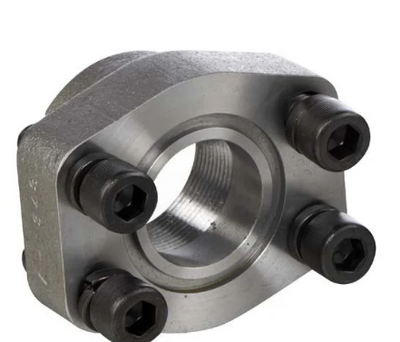
DIN four-bolt hydraulic flanges use an O-ring face and bolted clamp or flange load, but similarity to SAE or JIS patterns does not prove interchangeability. Form R and Form S are starting classifications; exact dimensions and ratings decide the joint.
The seal and clamp have separate functions
The male flange head carries an O-ring groove against a flat component port or mating face. Bolts provide clamp load. Inspect face, groove, O-ring, head thickness, clamps, bolt holes, and port condition.
Do not use bolts to pull a misaligned hose or tube into position. External load can distort the joint even when the O-ring initially seals.
Form R and Form S require their own data
Form R is associated with a standard/light flange series and Form S with a heavier-pressure series in applicable DIN systems. They can resemble SAE Code 61 and Code 62, but size-by-size dimensions, bolt spacing, head diameter and thickness, O-ring, and pressure-temperature rating must be confirmed.
There is no universal 3,000 or 6,000 psi rating for all sizes and materials. Component data and temperature derating govern.
Interchangeability must be documented
DIN 20066, ISO/SAE/JIS flange references may overlap in defined configurations, but standards editions and exact parts matter. Metric or inch bolts cannot be substituted merely because they pass through a hole. Thread, grade, length, washer, torque/preload instruction, and clamp design must match.
Measure both axes of the bolt pattern, flange head, port recess, O-ring, and nominal size. Record the standard and drawing revision.
After assembly, use the specified tightening sequence and verify the joint under controlled pressure and motion. A verified form and size—not visual resemblance—make the DIN flange replaceable.