
Realize Hydraulic Flange Benefits through Clamp Load and Service Geometry
HGW Hydraulics on May 12th 2022
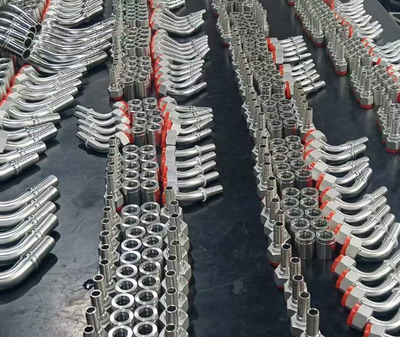
Hydraulic flanges do not improve a system merely by replacing a threaded fitting. Their benefits appear when the port, conductor, clamps, fasteners and service space are designed as one joint.
For large mobile and industrial lines, that design can simplify assembly while keeping the pressure boundary inspectable.
Use a flange where rotation creates the problem
Rigid pipe and tube cannot always rotate into a threaded component. A hose with an elbow may also need a fixed orientation. A flange head can be positioned without turning the conductor, then secured with split or one-piece clamps.
This reduces required tool swing around crowded pumps and manifolds. It should not be called effortless or moderate-torque assembly without the actual screw specification; fastener torque remains product-specific.
Remove adapters only when the route still works
A flange elbow or purpose-designed hose end can reduce conversion stacks in a hard-to-reach route. Fewer joints may reduce leak locations and installed height.
Count the complete route before claiming the benefit. If the flange body forces a sharp hose bend or needs several reducers, it may add more load than the threaded solution it replaced.
Distribute clamp load evenly
Four screws and paired clamps transfer load around the flange head. Correct alignment and a specified cross-pattern tightening sequence help seat the O-ring without tilting the head.
Uneven tightening can pinch or extrude the seal, distort hardware or leave one side underclamped. The joint is not comparable to a vehicle wheel simply because both use multiple fasteners; follow the hydraulic connection procedure.
Isolate vibration through routing and support
A flange can resist separation under demanding service when correctly selected and assembled. It cannot absorb unlimited lateral force from a heavy hose, unsupported tube or machine collision.
Place clamps and supports so normal motion is controlled without transferring bending into the port. Verify hose bend radius through the full equipment cycle and inspect for fretting or bolt movement after a routing change.
Make rigid-line maintenance possible
Split clamps allow a joint to open without rotating a continuous tube or pipe. This can shorten access for pump, motor, valve or manifold service and preserve the conductor's orientation.
Maintenance still needs a plan for trapped pressure, component weight, cleanliness and replacement of the O-ring. Ensure screws can be removed and the port face can be inspected before finalizing the layout.
Preserve the connection identity
Record standard, Code 61 or Code 62 series, size, head and groove, clamp, seal, screw details, conductor and orientation. OEM and international variants may look close while changing one of these fields.
Flange benefits come from controlled geometry and clamp load. When the system gives those features a clear job, the joint can be easier to build, inspect and service without relying on broad superiority claims.