
Pipe Flange Selection by Joint Function, Access, and Service Conditions
Nov 15th 2022
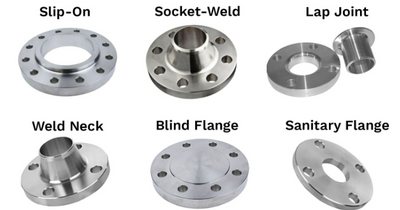
A flange is both a structural joint and a sealing platform. It connects pipe to pipe, valves, pumps, vessels, and other equipment while creating access for inspection or disassembly. The flange body does not seal by itself: the facing, gasket or seal, bolt load, alignment, and connected piping have to work together.
The families include welded designs such as weld-neck, slip-on, and socket-weld; rotating lap-joint assemblies; solid blind closures; and hygienic clamp connections. Each solves a different attachment, access, or cleaning problem. Selection begins with what the joint must do, then checks the governing piping code, dimensional standard, material, pressure-temperature rating, and fluid service.
Separate permanent attachment from removable access
Most flanged piping has a permanent connection between pipe and flange and a removable bolted connection between two flange faces. Welding joins the flange to the pipe. Bolts then compress a gasket or other specified seal between the mating faces. This arrangement lets a valve or equipment item be removed without cutting the entire line.
The load path extends beyond the bolts. Pipe weight, thermal expansion, vibration, nozzle loads, and misalignment can act on the joint. Supports and piping layout should bring the faces together without using bolts to pull a strained line into position.
ASME flange and fitting standards and ASTM material specifications are common in industrial piping. Hydraulic four-bolt flanges belong to another family governed by standards such as SAE J518 and ISO 6162. A hydraulic split flange should not be identified or assembled as though it were an ASME pipe flange simply because both use bolts.
Slip-on and socket-weld flanges simplify positioning in different ways
A slip-on flange passes over the pipe before fillet welds secure it. The loose positioning can make initial alignment convenient and may reduce fabrication difficulty for appropriate services. Its geometry and attachment differ from a weld-neck flange, so it should not be substituted based on nominal size alone.
Suitability for pressure, temperature, cyclic loading, and hazardous service comes from the applicable code and flange class. Describing all slip-on flanges as suitable across high and low conditions would ignore those engineering limits.
A socket-weld flange receives the pipe in a recessed socket and is welded around the outside. It is commonly associated with smaller-bore piping where compact alignment and a strong connection are useful. The specified insertion gap, weld procedure, material, and service restrictions must be followed. The internal crevice also matters when corrosion, cleanliness, or complete drainage is important.
Weld-neck flanges manage stress through a tapered hub
A weld-neck flange is butt-welded to pipe. Its tapered hub transitions from the flange thickness toward the pipe wall, helping distribute load through the connection. This makes the type common in demanding pressure-temperature and cyclic services when designed and fabricated under the applicable code.
The pipe schedule and bore should align with the flange preparation. Welding procedure, heat input, joint fit-up, examination, and any required heat treatment are part of the finished connection. The word “weld neck” does not establish a universal rating; size, class, material group, temperature, and standard do.
Long weld-neck and integral variations serve equipment nozzles and specialized connections. Those shapes should be specified from drawings rather than treated as ordinary pipe flanges with extra length.
Lap-joint assemblies prioritize rotation and material economy
A lap-joint system uses a stub end welded to the pipe and a backing flange that can rotate behind it. Rotation makes bolt-hole alignment easier, especially in prefabricated or repeatedly opened piping. Only the stub end contacts the process fluid, so the backing flange may sometimes use a less costly compatible material under the design rules.
This architecture can suit lined pipe, corrosion-resistant systems, or joints opened for cleaning and inspection. It also has different mechanical behavior from an integral flange. The stub-end facing, backing flange dimensions, gasket, and loading have to be selected as a system.
Blind flanges create a removable pressure boundary
A blind flange has no bore. It closes a line end, vessel nozzle, or future branch and can provide access for inspection or pressure testing. Because pressure acts across the full internal area, blind-flange loading can be significant. Correct class, thickness, material, facing, gasket, and bolting are essential.
Before removing a blind flange, the line must be isolated, depressurized, drained, and verified under the site's procedure. A solid plate and bolts should never be assumed safe merely because no flow opening is visible.
Sanitary connections are designed around cleaning
Food, beverage, pharmaceutical, and biotechnology systems often use sanitary clamp-style flanges or ferrules with smooth bores and cleanable seals. Quick disassembly supports inspection and cleaning, while controlled surface finish and minimal crevices help prevent retained product.
Standards such as 3-A and ASME BPE may apply depending on the system. Seal material, surface finish, drainability, cleaning chemistry, and hygienic installation matter more than visual similarity to another clamp connection.
Facing, gasket, and bolts complete the specification
Flange type is only one line on the data sheet. Record nominal size, class or applicable rating system, material, facing, gasket or seal, bolt specification, temperature, media, corrosion allowance, and required examination. Mating faces must be compatible.
During installation, inspect faces for scratches and debris, align the pipe without forced bolt-up, use the specified gasket, and tighten with the approved pattern and controlled method. Uneven or excessive bolt load can damage the gasket; insufficient load can open a leak path during pressure or temperature cycles.
Flanges are valuable because they combine a strong connection with planned access. Choosing the type by joint function—and then completing the material, rating, facing, and installation requirements—keeps that access from becoming the system's weakest boundary.