
Choose Flared or Flareless Tube Fittings from Tube Preparation and Service Duty
Sep 28th 2023
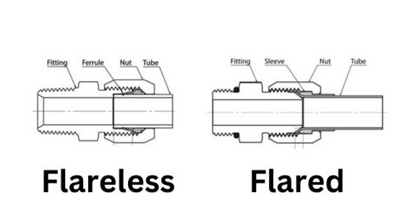
Flared and flareless fittings describe two broad ways of preparing and gripping tube. Neither category has one pressure limit, vibration ranking, or reuse rule. The correct choice is made from the specific fitting standard, tube material and wall, operating duty, assembly tooling, and the evidence that can be inspected after installation.
Start with how the tube becomes part of the seal
A flared connection forms the tube end into a cone. The flare is clamped against a matching seat, creating a metal-to-metal sealing interface. Common examples include 37-degree JIC-style and 45-degree flare systems. The angle, nut, sleeve, tube dimensions, and fitting standard must match.
A flareless connection leaves the tube end unflared and uses one or more ferrules, sleeves, or cutting rings. Tightening drives those components into controlled contact with the tube and fitting body. DIN 24-degree cutting-ring systems, single-ferrule bite fittings, and twin-ferrule instrumentation fittings are distinct designs, not interchangeable versions of one generic compression fitting.
Qualify the tube before choosing the fitting
Record tube outside diameter, wall thickness, alloy, temper or hardness, surface condition, ovality, and dimensional tolerance. A material that is too hard or a wall outside the flaring range can crack, thin, or form poorly. A ferrule may also fail to grip or deform correctly when tube hardness and wall do not meet its requirements.
Seamless versus welded construction, heat treatment, coatings, and corrosion exposure can matter in demanding service. Use tube specified or accepted by the fitting manufacturer and applicable system standard. Do not assume that a ferrule able to slide over the tube is qualified to bite it.
Compare assembly processes, not just tool counts
Flared assembly requires the correct cut, deburring, tube projection, 37- or 45-degree tool, and visual inspection of the finished cone. Flares should be concentric and free from splits, folds, scratches, thinning, and embedded debris. The nut and sleeve generally must be placed on the tube before flaring.
Flareless assembly still requires a square cut, deburring, cleanliness, full tube insertion, matched nut and ferrule components, and the specified tightening or presetting method. Some designs use turns from finger-tight; others use torque, gap inspection, a presetting machine, or a pull-up gauge. “Wrench only” does not mean “no controlled process.”
Use product data instead of a universal pressure threshold
Pressure capability varies with fitting family, size, tube wall, material, temperature, and assembly. Statements that all flared fittings are suitable above one pressure or all flareless fittings stop below another are unreliable. Compare the completed connection rating with working pressure, surge, impulse, and the machine design basis.
Gas service, vacuum, thermal cycling, cleanliness, fire-related requirements, and consequences of leakage may introduce additional qualifications. A metal seal avoids an elastomer at the primary interface but is not automatically gas-tight or suitable for every critical service.
Design against vibration and external load
Both types can work on vibrating machinery when properly selected, supported, and assembled. Flared seats can fret or loosen when tube alignment and clamp spacing are poor. Flareless rings can be improperly set, allow tube movement, or concentrate stress when preparation is wrong.
Route tube without using the fitting to pull misaligned sections together. Place supports according to the machine design, allow thermal movement, and avoid scratches where a ferrule grips or a flare bends. The connection should not carry unrelated equipment weight.
Plan inspection and disassembly before selecting reuse
A flare surface is directly visible after disassembly, which helps identify scratches, cracks, and uneven contact. Reassembly still depends on the seat, flare, thread, and nut remaining within the product instructions.
Flareless reuse varies. Some fittings permit controlled remake on the same prepared tube; others require a new ferrule, ring, or tube end. The amount of additional tightening can be limited. Never add turns repeatedly to stop a leak without inspecting grip and body condition.
For both styles, document the first assembly method and retain matched components. Mixing nuts, rings, and bodies from different designs can change geometry even when the thread or tube size is the same.
Match the fitting family to the maintenance environment
Flared systems can be practical where 37-degree hydraulic connections are already standardized and technicians have appropriate flaring equipment. Flareless systems can reduce tube-forming steps and suit thick-wall or instrumentation tubing when their grip and seal design is qualified. DIN mobile equipment, industrial panels, process instruments, aerospace assemblies, and water systems each use particular standards rather than a generic industry preference.
Consider access, assembly skill, tool calibration, spare parts, cleanliness, inspection, and repair time. A connection that performs well in production with presetting equipment may be difficult to reproduce during remote service; a field flare may be unsuitable when tube material control is poor.
Record the complete tube joint
Specify standard and series, flare angle or ferrule design, tube OD and wall, material and hardness requirement, pressure and temperature, fluid, body material, nut and sleeve or ring part numbers, assembly procedure, and inspection criteria.
That record makes the selection independent and repeatable. The decision is not simply flare versus no flare; it is a choice between two qualified tube-end systems whose preparation, sealing, gripping, and service behavior fit the actual application.