
How Forging and Casting Shape Stainless Steel Components
Oct 13th 2022
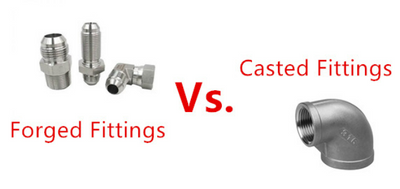
Forging and casting describe how a stainless steel component takes shape, not the complete quality of the finished part. Forging deforms solid metal with compressive force. Casting fills a mold with molten alloy and allows it to solidify. Those different thermal and mechanical histories influence grain flow, possible defects, shape complexity, machining, cost, and inspection.
Neither process is automatically superior for every fitting, valve, pump, or machine component. The decision depends on load path, geometry, alloy, heat treatment, corrosion exposure, production quantity, and the controls used by the manufacturer.
Forging works the metal around a load-bearing shape
In a forging operation, heated or cold metal is pressed, hammered, rolled, or otherwise deformed between tools. The working action can refine and direct grain flow through the component. Proper process design can produce dense parts with favorable toughness and fatigue behavior, especially where stresses follow a predictable path.
Forgings are common for compact bodies, rings, flanges, shafts, and fittings that experience mechanical load or pressure. Material is normally left for subsequent machining of threads, seats, ports, and sealing surfaces. The forging does not create those final precision features by itself.
Forging also has limitations. Tooling and process development add cost, and very intricate internal passages may be impractical. Laps, underfill, scale, decarburization, or unfavorable grain flow can occur when the process is poorly controlled. A forged label is therefore not a substitute for material certification, heat treatment, dimensional inspection, and any required nondestructive examination.
Casting creates complex geometry from liquid metal
Casting melts the stainless alloy, pours or injects it into a mold, and controls solidification to form the component. It can produce complex external shapes, internal cavities, and integrated features that would require extensive machining or multiple pieces if forged.
Valves, pump bodies, impellers, manifolds, and specialized machinery parts are common casting candidates. Different casting methods offer different surface finish, dimensional capability, tooling cost, and production volume. The selected alloy and heat treatment can be tailored to corrosion, temperature, wear, and mechanical requirements.
Solidification introduces its own risks. Shrinkage, gas porosity, inclusions, hot tearing, and microstructure variation can occur if mold design, melt quality, feeding, and cooling are not controlled. Inspection methods and acceptance criteria should be chosen around the critical areas of the part rather than assuming every casting contains harmful porosity.
Strength depends on process plus alloy and section design
Forged components often provide strong fatigue and impact performance because working can refine the structure and reduce certain solidification defects. This is useful for high-load parts where crack initiation and propagation are central concerns.
Cast stainless can still meet demanding mechanical requirements when alloy, section thickness, heat treatment, and quality controls are appropriate. Its strength should be evaluated from the specified grade and casting standard, not from a general comparison with a different forged alloy.
Geometry can change the result. A forged body with sharp transitions or excessive machining may concentrate stress. A cast body can place material efficiently around a complex passage but needs radii, wall transitions, and feeding designed for sound solidification. Engineering analysis and actual material properties are more reliable than the process name alone.
Corrosion resistance is primarily an alloy and surface question
Stainless corrosion resistance comes from its alloy chemistry and passive surface film. Chromium content, nickel, molybdenum, carbon control, heat treatment, welding, contamination, surface finish, and the service environment all affect performance.
Forging can promote a uniform wrought structure, while casting can produce segregation that must be controlled through alloy and heat-treatment practice. That does not mean a forged part always resists corrosion better than a casting. A properly specified cast alloy may outperform an unsuitable forged grade in a particular chemical environment.
For hydraulic components, also examine crevices, stagnant areas, dissimilar metals, chloride exposure, and damage to sealing surfaces. Passivation or cleaning requirements should be tied to the actual alloy and manufacturing route.
Shape, quantity, and machining drive commercial differences
Forging tooling can be economical for repeated production of suitable shapes, but the initial dies and presses are significant. Material may need trimming and extensive machining. Casting can reduce machining for complex bodies and consolidate features, although patterns, molds, yield loss, and inspection add their own costs.
For a simple high-load component, forging may provide an efficient material path. For an intricate housing with internal flow passages, casting may avoid an impractical amount of machining and assembly. Low quantities, very large parts, tolerances, and delivery schedule can change the balance.
Production time should be evaluated from the actual supplier route. A cast part is not automatically faster, and a forging is not always a custom slow process. Tool availability, alloy lead time, heat treatment, machining, and inspection often control delivery more than the basic forming method.
Specify the finished component, not only the process
A useful drawing or purchase specification identifies alloy grade, applicable material standard, heat treatment, dimensions, surface finish, pressure or mechanical requirements, corrosion environment, inspection, traceability, and acceptance criteria. It should state forging or casting where the process is part of the engineering requirement.
For pressure-containing parts, confirm that the component design and testing are appropriate to the governing application. For replacement work, do not substitute a cast or forged version solely because the external dimensions match; internal passages, wall sections, material properties, and qualification may differ.
Forging is valuable when worked grain flow, density, and load-bearing performance suit the part. Casting is valuable when complex geometry and alloy flexibility justify controlled solidification. The right comparison is between two fully specified components, not between two manufacturing labels.