
Evaluate Forged Hydraulic Bodies by Design, Material Flow, and Verification
HGW Hydraulics on Jul 7th 2026
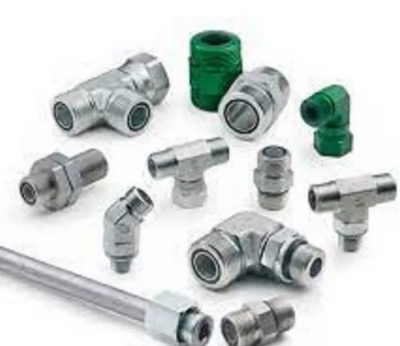
Forging can create a compact, strong hydraulic fitting or valve body, but the manufacturing-process label does not establish pressure rating or service life by itself. Material grade, grain flow, reduction, die design, heat treatment, machining, surface condition, inspection, and final geometry all influence performance.
The useful purchasing question is not “Is forging always superior?” It is “Which process produces the required body with controlled properties and verified pressure integrity?”
Forging moves solid metal into a near-net shape
In closed-die forging, heated or cold material is forced to fill a die cavity. The process can orient grain flow around the part geometry and reduce the amount of machining compared with starting entirely from bar. Properly designed forgings can provide favorable strength, ductility, fatigue behavior, and material use.
Complex elbows, tees, valve bodies, and wrench flats can be formed near their final external shape, then machined to create threads, seats, bores, and sealing faces. The process must control laps, underfill, scale, decarburization, die mismatch, and other discontinuities.
“One piece” does not mean defect-free. Inspection and process qualification remain necessary.
Casting, brazing, and machining solve different geometry problems
Casting pours molten metal into a mold and can form internal passages or complex shapes economically at suitable volumes. Porosity, shrinkage, inclusions, and mechanical properties depend on alloy and process controls. A qualified casting is not automatically unsuitable for pressure service.
Brazing joins prepared components with a filler metal below the base materials’ melting temperatures. It can create geometries difficult to machine or forge as one piece. Joint design, cleanliness, filler, heating cycle, clearance, and inspection control its performance.
Machining from bar or billet offers flexibility and dimensional control, especially at lower volume, but can cut across grain flow and remove more material. Fabrication and additive processes provide other options with their own qualification needs.
The correct comparison uses the actual drawing, alloy, rating, inspection, and application—not a blanket ranking.
Fittings and valves place different demands on the body
A fitting body must maintain thread, seat, and wrench geometry under pressure and assembly load. A valve body adds internal cavities, stem or cartridge interfaces, sealing surfaces, flow forces, and sometimes thermal gradients.
Wall thickness alone does not determine thermal-fatigue resistance. Thick and thin transitions, local stress concentration, material, temperature rate, restraint, and duty cycle matter. A compact forged body can be advantageous, but analysis and testing must cover the final machined shape.
For corrosive media, base alloy and heat treatment can be more important than the forming route. Carbon steel, stainless steel, brass, and higher alloys each require their own process window and compatibility review.
Pressure rating belongs to the finished component
Do not infer allowable pressure from forging press force or from the strength of a blank. The finished part includes minimum wall sections, drilled intersections, threads, seats, surface marks, heat-treatment condition, and seals.
Rating should be supported by the applicable design standard, material data, dimensional control, proof or burst testing where required, fatigue or impulse validation where applicable, and documented quality processes. Temperature derating and fluid compatibility remain part of selection.
If a forged adapter connects to a lower-rated hose, tube, port, flange, or seal, that adjoining component can control the assembly.
Production volume changes the economic answer
Forging dies and process development require upfront investment, so repeat volume can make forging economical. Low quantities, prototypes, unusual alloys, or frequent revisions may favor machining or another route. Secondary machining, heat treatment, coating, inspection, scrap, lead time, and tooling maintenance belong in total cost.
For overseas production, drawings, die ownership, revision control, approved material sources, first-article inspection, batch traceability, and replenishment planning should be settled before volume production. Geography does not replace process evidence.
Verify what the purchase order actually requires
Specify material and condition, manufacturing route when technically necessary, dimensions and tolerances, threads and seal surfaces, heat treatment, coating, marking, cleanliness, testing, documentation, and nonconformance handling.
Review a first article against the controlled drawing before relying on appearance. Similar forged shapes can conceal different bores, seat angles, thread classes, or material conditions. Isolate a batch if identification or inspection evidence conflicts with the approved record.
Forging is valuable when it places material efficiently around a demanding hydraulic geometry and the process is controlled through final verification. It should be selected for those measurable advantages, not used as a substitute for rating data, inspection, or application review.