
Compare Forged and Cast Fitting Bodies from Finished-Part Evidence
HGW Hydraulics on Nov 28th 2023
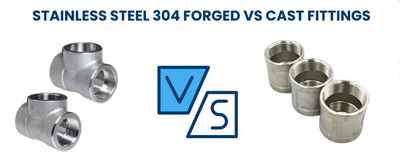
Forging and casting create different starting structures, but the process name alone does not establish a fitting's strength, pressure rating or service life. Alloy, heat treatment, geometry, defect control, machining and finished-part qualification determine whether a component is suitable.
The useful comparison identifies each process's risks and the evidence used to control them.
Follow the material path
A closed-die forging deforms a heated solid billet toward the required shape. Grain flow can follow the part contour, and deformation plus heat treatment can produce useful strength and toughness.
A casting fills a mold with molten metal and solidifies into shape. It can create complex internal or external geometry with less deformation and machining. Its structure depends on alloy, solidification, feeding, cooling and subsequent treatment.
Neither description guarantees uniformity. Forgings can develop laps, underfill, scale or heat-treatment problems. Castings can develop shrinkage, gas porosity, inclusions, hot tears or cold-shut defects.
Compare properties at the exact section
Published bar, forging or casting properties may not represent the thickest body transition, threaded end or machined sealing face. Require the material grade, product form, heat-treatment condition and applicable mechanical requirements for the actual part.
High hardness is not a substitute for toughness. A component exposed to impact, vibration or assembly load needs the required balance of strength and ductility.
Do not use an unrelated grinder-insert comparison to rate a hydraulic fitting. Its alloy, heat treatment, geometry and failure modes are different.
Control defects with appropriate inspection
Process controls should address billet or melt identity, forming temperature, die or mold condition, heat treatment and machining. Inspection can include visual and dimensional checks, material verification and nondestructive examination where the drawing or consequence requires it.
Porosity is a casting risk, not proof that every casting leaks. A qualified casting can serve pressure equipment when its standard, design and inspection support the application. A forging also needs sound material and finished-bore integrity.
Rate the finished connection
Pressure capability comes from wall sections, stress concentrations, threads or seats, material and qualification tests. The seal, attached conductor and port may limit the assembly before the body material does.
Use product data for the exact size and temperature. “Forged” should not be translated into an unsupported higher-pressure promise or longer guaranteed life.
Build a repeatable purchasing specification
Record material grade, manufacturing route, heat treatment, dimensions, connection standard, surface finish, coating and required inspection. For outsourced production, use drawing revision, first-article approval, lot identity and nonconforming-product controls.
Forging often offers an efficient path to strong shaped steel bodies, while casting can economically create other qualified geometries. The correct choice is supported by finished-part evidence rather than a universal ranking of processes.