
Choose One-Piece Forged or Brazed Fitting Construction from Joint Evidence
HGW Hydraulics on Dec 7th 2023
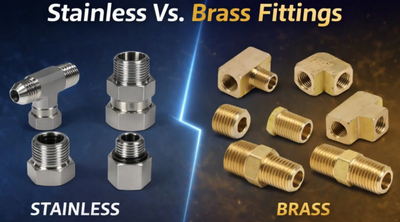
A shaped fitting can be formed as one body or assembled from separate pieces with a brazed joint. One-piece construction removes that secondary joint, but it does not make every forging stronger than every properly designed brazed fitting.
Selection should compare the real part, joining procedure and qualification for the service.
Understand how the body is created
Forged shapes begin with billet formed under compressive load, then trimmed, cleaned, heat treated and machined as required. Straight adapters may instead be machined from qualified round or hexagonal bar.
Threads, sockets, bores and sealing faces are secondary operations. Their dimensions and surface condition can control the connection even when the blank is sound.
A brazed construction positions two or more compatible pieces and joins them with a filler metal that flows through the prepared joint under controlled heat. Joint clearance, cleanliness, filler, temperature and time affect the result.
Count interfaces without assuming failure
A one-piece elbow or tee removes the metallurgical interface present in a brazed assembly. This can simplify pressure-boundary inspection and avoid a joint located in a highly stressed transition.
A brazed joint is a potential failure location only if design, processing or service loads are inadequate. Qualified brazing is an established joining method; it should not be described as inherently cracked or leaking.
Compare where the joint sits relative to bending, vibration, heat and corrosive media. A well-placed joint can be acceptable while a poor one-piece geometry can still concentrate stress.
Verify material and end standards
Carbon and stainless steels cover many grades and conditions. “304,” “316” or “carbon steel” is incomplete without product specification and heat-treatment state.
Threaded pipe ends, socket-weld ends and hydraulic adapter faces follow different standards. ASME B1.20.1 defines NPT thread form, while ASME B16.11 covers specified forged socket-welding and threaded fittings; those references do not automatically govern every hydraulic adapter.
Require process-specific evidence
For forgings, control material heat, forming, heat treatment, machining and surface defects. For brazing, control base and filler materials, joint design, cleaning, fit-up, thermal cycle and operator or procedure qualification as required.
Use dimensional inspection and the specified pressure, leak or nondestructive tests. A visual bead or smooth forged surface cannot substitute for acceptance criteria.
Match construction to procurement and maintenance
One-piece shapes may reduce part count and joint-traceability work. Brazed designs can enable geometries or production volumes that would be inefficient to forge and machine.
Record body construction, drawing revision, connection ends, materials, ratings and inspection records. Choose the one-piece or joined part that demonstrates adequate performance in the actual size, temperature, pressure and load—without promising service life from process name alone.