
Create a Hydraulic Hose Replacement Record from Four Measurements
HGW Hydraulics on Sep 21st 2021
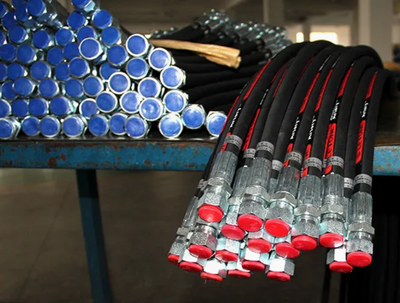
Inside diameter, outside diameter, length, and flow are four useful hose measurements, but none should be recorded without the fitting ends and installed route. A replacement can match nominal size yet be unsafe because its hose series, pressure, material, end orientation, or motion envelope differs.
The goal is a reproducible assembly record, not a number copied from a worn hose.
1. Confirm inside diameter from product identity
Read the layline for manufacturer, hose series, standard, size, pressure, temperature, and date information. Dash notation often uses sixteenths of an inch, so -8 frequently indicates a nominal 1/2-inch hose ID, but exceptions exist. Confirm the actual product data.
Do not cut an installed pressure hose merely to measure ID unless it has been safely removed and the replacement/investigation procedure permits destructive inspection. A worn or swollen cut end may not represent the original dimension.
ID affects average velocity and pressure loss. A small passage can create excessive loss and heat; oversizing may reduce velocity but add volume, weight, cost, and routing difficulty. Suction, pressure, return, and drain paths use different criteria.
2. Measure outside diameter at the routing constraint
Hose OD includes tube, reinforcement, and cover and varies by series and manufacturer. Measure an undamaged, uncompressed section and compare with product tolerances.
OD controls fit through bulkheads, clamps, sleeves, guards, reels, and articulation spaces. A replacement with the same ID can have a larger OD or minimum bend radius and may not follow the original path.
Clamps should match the installed hose and support it without crushing the cover.
3. Define finished length by end-point convention
Finished assembly length is measured between fitting reference points defined by the hose assembler—often sealing ends, centerlines for elbows, or another catalog convention. “Maximum distance between ends” is not precise enough for mixed fitting shapes.
Record end types, drop lengths, elbow angles, and clocking. Cut length is calculated using the hose system’s insertion or cutoff factors; do not subtract a generic ferrule dimension.
Allow required motion and contraction/elongation behavior without installing the hose under tension. An arbitrary quarter-inch tolerance is not suitable for every short or critical assembly.
4. Use peak path flow, not only pump nameplate
Record volumetric flow in GPM or L/min for the actual branch and operating condition. Pump maximum flow may not reach every function, and cylinder return flow can exceed pump flow because chamber areas differ.
Use hose and fitting internal area to evaluate velocity and loss. A coupler, elbow, adapter, or fitting stem can be the minimum passage. Consider cold viscosity, simultaneous functions, transients, and return peaks.
Nomograms are useful screening tools when their fluid, units, and recommended velocity basis match the circuit. Complete sizing may require pressure-drop calculation and manufacturer data.
Add the properties that measurements cannot show
Record hose construction, reinforcement, working-pressure and impulse specification, temperature, fluid compatibility, vacuum requirement, cover/environment, minimum bend radius, fitting system, crimp data, protection, and applicable standard.
Photograph the route in key machine positions and mark which end connects to which port. Preserve approved image and part records, but do not reuse a hose merely because it looks clean.
Identify both fitting ends independently
Record thread diameter and pitch, seat or O-ring location, male/female, swivel/fixed, body angle, material, and port standard. A hose may have JIC on one end and ORB, ORFS, BSP, metric, flange, or another interface on the other.
For two elbow ends, clocking describes their angular relationship. Establish the supplier’s viewing and measurement convention before writing a degree value. Incorrect clocking can twist the hose even when overall length is correct.
Check fitting stem bore and any quick coupler or adapter because the smallest passage may control loss. Do not infer the assembly rating from the hose layline alone.
Preserve evidence from a failed assembly
If the hose is being replaced after a leak, mark the damage location and keep the coupling attached until root-cause inspection is complete. A rupture near the ferrule, mid-hose abrasion, heat damage, or a kink requires different correction.
Update the replacement record with the actual cause and revised routing, support, guard, or specification. Otherwise the database can reproduce the failure precisely.
After installation, verify no twist, adequate tangent near couplings, clearance, support, and behavior through the safe motion cycle. Four measurements become valuable when they sit inside this complete assembly record.