
Galvanized Malleable Iron Pipe Fittings: Where Zinc Coating Helps and Where It Does Not
HGW Hydraulics on Apr 29th 2025
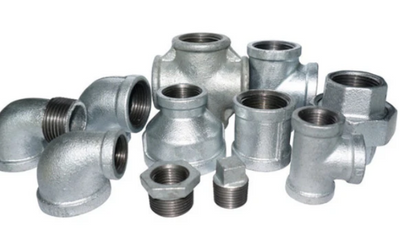
Galvanized malleable iron fittings combine an annealed iron casting with a zinc coating. The casting process provides threaded elbows, tees, unions, reducers, caps, bushings, flanges, and branches in compact shapes. Galvanizing delays corrosion of the iron surface in suitable atmospheres and fluid services.
The material is common, but it is not a universal hydraulic or process connection. Pressure-temperature rating, thread, coating, media, code, and installation must match the exact product.
Malleabilizing changes the cast structure
Malleable iron begins as a white-iron casting and receives a controlled heat treatment. Annealing changes the carbon structure and improves ductility and toughness compared with the brittle starting condition. ASTM A197 is one material specification for cupola malleable iron castings.
This manufacturing route is different from forged steel, ductile iron, or ordinary gray iron. Material marking and product standard should be verified rather than inferred from a black or galvanized appearance.
ASME B16.3 covers threaded malleable iron fittings, while ASME B16.39 addresses threaded malleable iron unions. Other shapes such as plugs, bushings, and locknuts can fall under additional standards.
Zinc protects sacrificially
Hot-dip galvanizing immerses prepared iron or steel in molten zinc, producing bonded zinc-alloy layers and an outer zinc surface. Zinc corrodes preferentially and can protect small exposed areas of the iron. Relevant hardware products may specify hot-dip coating requirements under ASTM A153/A153M.
Coating life depends on thickness, atmosphere, moisture cycles, chemicals, abrasion, cut threads, and storage. Zinc can be consumed in acidic or strongly alkaline conditions and can contaminate some fluids. It is not appropriate for every gas, water, food, chemical, or high-temperature service.
White corrosion products on zinc and red rust from exposed iron indicate different stages and should be evaluated separately.
Thread standard and application remain independent
NPT under ASME B1.20.1 is common on North American malleable iron fittings. BSP-family products also exist. NPTR and other special pipe threads serve different purposes and should not be substituted for a pressure joint.
Confirm nominal size, male/female end, pressure class, material, coating, and governing code. A floor flange or railing fitting designed for mechanical structure is not automatically a pressure-containing pipe fitting.
Likewise, a threaded malleable iron fitting should not be placed in high-pressure hydraulic service unless its exact standard and rating support that use.
Common uses depend on local codes
Galvanized malleable iron appears in suitable water distribution, air, HVAC, fire-protection, industrial utility, agriculture, and mechanical structures. Gas and fire systems are code-controlled, and galvanized surfaces can be restricted or required according to jurisdiction and service.
Outdoor railings and scaffolding use different structural products and thread engagement from a fluid system. Waste, steam, potable water, compressed air, and process media also impose separate rules.
Consult the authority having jurisdiction and the equipment or piping specification rather than relying on familiarity.
Assemble without destroying the coating or casting
Inspect threads for damage, zinc buildup, bare areas, cracks, and debris. Use the specified compatible tape or compound on pressure-joint threads. Start by hand to avoid cross-threading and hold the pipe and fitting with suitable wrenches.
Excess torque can crack or distort a cast fitting and remove coating at wrench contact. Adding compound does not repair a split body or mismatched thread. After assembly, test by the applicable safe procedure and inspect for leakage.
Protect galvanized parts from wet storage and contact with incompatible metals or chemicals. When field-cutting pipe or damaging a coating, follow the approved repair method.
Select from the complete specification
Record size, shape, standard, material, pressure-temperature class, thread, zinc-coating requirement, media, external exposure, and documentation. Check compatibility with downstream valves, seals, and other metals.
Galvanized malleable iron fittings are durable when an annealed casting and zinc coating match the intended piping or structural job. Their widespread use is a reason to verify the standard—not a reason to assume every familiar elbow is suitable for every fluid system.