
Identify French GAZ 24-Degree Connections by Seat, Lip, and Thread
HGW Hydraulics on Feb 3rd 2022
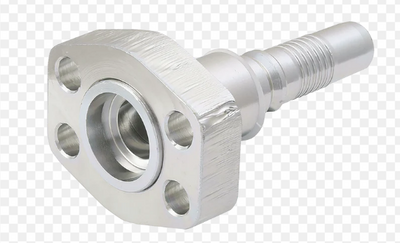
The French GAZ 24-degree equipment connection appears on selected imported hydrostatic and mobile hydraulic components. Shops sometimes group it with hydraulic flanges, yet its sealing face and fine metric retention thread require their own identification.
The important evidence is the 24-degree mating geometry and projecting lip—not the equipment's country alone.
Inspect the face before measuring the thread
The male connection has a raised feature that projects from the surrounding face and mates with a corresponding 24-degree seat. That geometry differs from an SAE four-bolt flange head sealing through an O-ring against a flat port.
Clean the component and view it face-on. Record the projecting diameter, seat angle, sealing contact and any damage. A worn lip can make the part look flatter than it was originally.
Measure the metric retention details
Use calipers and a metric pitch gauge to capture major diameter, pitch and usable thread length. Do not assume that a nearby German 24-degree tube fitting shares the same thread merely because both are metric and mention the same angle.
Compare the measurements and face profile to a reliable drawing for the exact connection size. Thread engagement without correct seat contact cannot produce the intended joint.
Rule out look-alike flange families
Code 61, Code 62, Japanese four-bolt and OEM clamp flanges use bolt patterns, flange heads and O-rings. A 24-degree GAZ connection uses a different mating concept. Similar port scale or pressure service does not create interchangeability.
Also distinguish it from a DIN/ISO 24-degree tube connector. A tube connector can use a cutting ring or an O-ring cone on plain-end metric tube, while the French equipment connection has its own component interface.
Capture the installed application
Record machine model, component location, working and transient pressure, fluid, temperature, conductor type and available clearance. Photograph both the removed part and the port before adapters are separated.
If an earlier repair added a conversion, identify the original equipment port and the serviceable hose end independently. The hose currently attached to the machine may use a common U.S. connection while an adapter contains the GAZ interface.
Protect an uncommon port during replacement
Do not test candidates by force. Damage to an uncommon female seat can turn a fitting replacement into a component repair. Cap the clean port with protection designed for storage while the connection is identified.
For recurring U.S. service, preserve a dimensioned record and the approved conversion or replacement part. Common sizes may justify local stock; rare configurations need revision-controlled drawings and a replenishment path.
A French GAZ 24-degree replacement is successful when the thread retains the part and the matching seat creates the seal. Neither function can be inferred from the word “metric.”