
A Five-Check Method for Measuring Unknown JIC Fittings
HGW Hydraulics on Jul 25th 2023
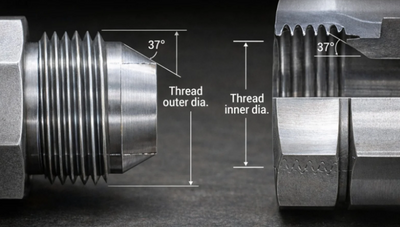
JIC size cannot be confirmed from a single diameter. A correct identification links the 37-degree sealing seat, straight thread diameter, thread pitch, dash size, and mating component. Missing any one of those checks can turn an “almost fit” into a damaged flare or wrong order.
Use clean samples and proper gauges. If the fitting came from a machine, document its location and the opposite end before separating parts; that context often resolves look-alike standards.
Check 1: establish end type and gender
A male JIC end has external straight threads and a projecting 37-degree cone. A female end has internal threads and a corresponding flare seat, often inside a swivel nut. The thread supplies clamping force, while contact at the cone contains the fluid.
Clean the seat without scratching it. A missing cone, flat face with an O-ring, tapered thread, or port O-ring indicates another family. Gender should describe the connection end, not the body shape or hose stem hidden behind the nut.
Check 2: measure the thread at the correct surface
Use calipers across the crests of a male thread. Female measurements are less direct and should be verified with the mate, thread gauge, or drawing. Record in inches and do not round prematurely.
JIC uses UN/UNF straight threads under SAE J514 dimensional conventions. Common examples include 7/16-20 for -4, 9/16-18 for -6, 3/4-16 for -8, 7/8-14 for -10, and 1-1/16-12 for -12. A current table should be used for the full size range.
Thread OD is not the same as tube OD. A -8 fitting has a nominal one-half-inch tube relationship but a 3/4-inch thread.
Check 3: verify threads per inch
Fit an inch thread-pitch gauge to the clean thread and look for light or rocking between teeth. Adjacent sizes can have similar diameters but different pitches. A ruler can provide a rough count across several threads, but it should not be the final control for ordering.
If no gauge fits cleanly, consider thread damage, coating, a metric standard, BSPP, ORB, or a different flare family. Do not force a known JIC nut onto the sample as a substitute for measurement.
Check 4: confirm the 37-degree seal
Use an appropriate flare-angle gauge or compare the drawing, not unaided eyesight. SAE 45-degree flare and various 30-degree connections can resemble JIC in a small fitting. A mismatched cone may touch at a narrow ring and appear tight while leaving insufficient contact.
Inspect the complete circumference for radial scratches, dents, corrosion, and uneven witness marks. A fitting can be correctly sized and still leak because the seat is damaged or the tube flare is off-center.
Check 5: map measurements to dash size and mate
JIC dash numbers commonly correspond to nominal tube outside diameter in sixteenths of an inch: -4 to 1/4, -6 to 3/8, -8 to 1/2, -10 to 5/8, -12 to 3/4, and -16 to 1 inch. Confirm the thread-size pairing in an SAE J514 reference rather than calculating the thread from the dash number.
Then verify the other half of the connection. The female thread and flare must match, and the tube or hose end must be the correct size and assembly system. Check whether the replacement also needs a bulkhead, swivel, elbow, tee, reducer, or another opposite-end standard.
Rule out the most common look-alikes
ORB can share some UN/UNF thread sizes with JIC but seals with an O-ring at a port. NPT is tapered and uses pipe-thread sealing. BSPP has a 55-degree Whitworth profile and can use several face or cone seals. SAE 45-degree flare uses a different seat angle. AN also uses a 37-degree flare but belongs to specifications and applications that should not be substituted merely from geometry.
Thread tape on a JIC thread is a warning sign. The thread is not the normal seal, and tape can hide an incorrect or damaged flare.
Record enough information to reorder once
For purchasing, retain caliper and pitch readings, dash size, male/female end, a clear seat photograph, body shape, material, opposite-end connection, tube or hose size, equipment location, and part markings. If the assembly is large or safety-critical, use the equipment documentation or a qualified inspection process.
After installation, follow the specified tightening and pressure-test method. Do not look for a high-pressure pinhole with a hand.
Measuring a JIC end is a chain of confirmation rather than a one-step lookup. The result is dependable only when thread, pitch, 37-degree seat, dash-size relationship, and mate all point to the same standard.