
Control Hydraulic Contamination from Receiving Through Return to Service
HGW Hydraulics on Apr 11th 2024
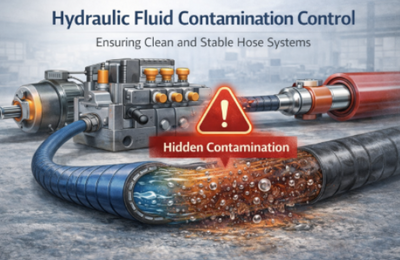
Hydraulic contamination control begins before oil enters the reservoir and continues through component manufacturing, storage, assembly, field repair, and restart. Filters are important, but they cannot compensate for open ports, dirty transfer containers, damaged seals, or a repair that releases chips directly downstream of the filter.
Define the cleanliness target by component sensitivity
Servo valves, proportional controls, pumps, bearings, cylinders, and general mobile circuits can have different particle sensitivity. Use the equipment or component manufacturer’s cleanliness requirement and an appropriate reporting method. “Looks clean” is not a measurable acceptance criterion.
Plan sampling points, filter locations, transfer filtration, flushing, and verification before a new system or major repair is commissioned. A sample taken from the top of a quiet reservoir may not represent contamination circulating at a critical valve.
Track contamination sources by stage
New tube, hose, fittings, manifolds, valves, and reservoirs can contain machining chips, abrasive, weld debris, dust, fibers, rust, and packaging material. Hose cutting and crimping can introduce particles. Field work adds soil, shop towels, old sealant, and moisture.
In service, pumps, seals, bearings, and surfaces generate wear debris. Damaged breathers and rod seals admit dirt and water. Cooler leaks, condensation, washdown, and poor drum storage introduce moisture. Each source needs a control at the point where it enters.
Keep fluids sealed, identified, and filtered during transfer
Store drums and totes closed, dry, protected, and clearly labeled by exact fluid. Use dedicated or verified-clean transfer equipment and closed connections where practical. Filter new oil to the system requirement during transfer when the program calls for it; new delivery does not guarantee machine-level cleanliness.
Avoid open buckets, funnels, and unprotected top-offs. Do not mix fluids or additive packages without responsible approval. Water can alter lubrication, promote corrosion, react with additives, and support sludge or biological problems in some systems.
Protect every open port and clean assembly
Install clean caps and plugs on hose assemblies, fittings, tubes, valves, and components promptly after cleaning or disconnection. Protective closures keep out particles and moisture during manufacturing, storage, transport, and maintenance. A shipping cap is not automatically clean enough for a critical hydraulic circuit.
Clean cut hose and fabricated tube by the specified process, then cap them. Control deburring, weld cleaning, manifold cross-drills, thread sealant, and assembly lubricant. Keep wiping materials and tools appropriate to the cleanliness requirement.
Treat seals as both barriers and debris sources
Correct rod seals, wipers, O-rings, backup rings, and gland geometry help exclude contamination and retain fluid. Wrong material, damaged lips, poor installation, pressure extrusion, excessive clearance, and worn rods can release elastomer fragments or admit dirt.
Nibbling or extrusion on the low-pressure side of an O-ring is evidence that can involve pressure, gap, temperature, hardness, backup support, or installation. Simply fitting a harder compound can shift the problem. Preserve the seal and inspect the mating hardware before choosing a correction.
Use filtration and condition data together
Select filters for required cleanliness, flow, viscosity, pressure, collapse protection, and location. Monitor differential indicators and change elements under the program rather than bypassing a loaded filter. Breathers, desiccant devices, offline filtration, magnetic collection, and water-removal methods may be useful where the risk supports them.
Particle count, water analysis, viscosity, acid or oxidation indicators, elemental analysis, patch inspection, and filter-debris examination answer different questions. Trend samples taken consistently. A lower particle count after a filter change does not prove that a corrosion or water source has been removed.
Flush and restart as controlled work
After fabrication, component failure, or fluid change, define the flushing circuit, temporary filters, target flow and temperature, valve positions, cleanliness endpoint, and sample method. Protect sensitive components where the procedure requires it. Flushing with an incompatible fluid or pushing debris into a servo valve creates a new failure.
Before restart, verify caps removed from intended connections, ports closed, reservoir level, filter installation, breathers, hose and tube routing, and leak-free assembly from a protected position. Stored energy and injection hazards still apply during contamination work.
Connect contamination findings to corrective action
Record particle type, size or analysis, sample location, water evidence, component wear, seal condition, maintenance event, and disposition. Metal fragments after a pump failure require a different response from silica dirt after an open-air repair or rust after water ingress.
A complete program controls receiving, storage, transfer, fabrication, installation, operation, and repair. Clean fluid, correct seals, filtration, and capped components are visible practices; the stronger system also measures results and removes the source that made the contamination in the first place.