
Interpret Hydraulic Fitting Burst Tests as Assembly Evidence
HGW Hydraulics on Sep 17th 2025
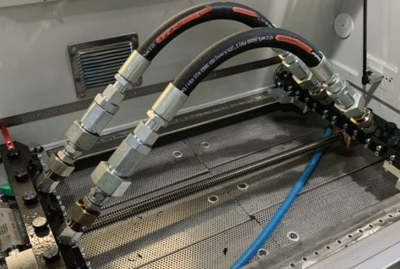
A burst result belongs to the specimen that was tested. It does not create a universal pressure rating for every size, alloy or connection in the same product family. The useful evidence is the complete record: components, assembly method, test procedure, pressure trace and failure location.
Separate working, proof, and burst conditions
Working pressure is the permitted service limit established by the applicable design basis. A proof test checks integrity at a specified level without intended permanent damage. A burst test raises pressure until loss of containment or another defined endpoint.
These values serve different purposes. Dividing one burst event by an arbitrary factor is not enough to set a catalog rating. Temperature, cyclic loading, material variation, corrosion and connection standard also influence safe service.
Define the complete test article
Record fitting part number and lot, material, size, tube outside diameter, wall, grade and hardness, ferrules or sleeve, lubricant and assembly procedure. Note whether tube ends were freshly prepared, preset or remade.
Fixtures, adapters, plugs and instrumentation must be rated for the program. Their stiffness and alignment can affect loading. Photograph the assembly before and after testing so deformation and failure origin can be reviewed.
Let the failure mode explain the limit
If the tube wall ruptures while the fitting retains grip and does not leak, the test shows that this tube specimen controlled the final event. A pullout, ferrule slip, cracked body, thread failure or seal leak points to a different limit.
Failure outside the fitting does not mean the fitting can safely be operated at the observed burst pressure. It shows only that the connection outlasted another element under the stated test conditions.
Build a repeatable program, not a demonstration
Control test fluid, temperature, pressure ramp, hold points, data-acquisition rate and acceptance. Calibrate transducers and maintain a protected test area. Hydrostatic testing can reduce stored energy relative to gas testing, but high-pressure liquid release remains hazardous.
Multiple specimens and relevant production lots provide more information than one video. The governing standard or qualification plan may also require proof, leakage, impulse, vibration, thermal or corrosion testing. Use sample quantity and statistical treatment appropriate to the product decision.
Apply results only within the qualified range
Changing tube wall, material, fitting size, heat treatment, ferrule design or assembly tool can change the failure mode. Validate substitutions rather than assuming a similar-looking connector carries the same margin.
In procurement, request the published working-pressure basis and applicable standard, then confirm that the hose, tube, port and adapters do not introduce a lower limit. Store the report with its exact configuration.
Burst testing is valuable because it exposes where a defined pressure boundary stops being intact. Its credibility comes from disciplined scope and failure analysis, not the largest pressure number on the gauge.