
Hydraulic Fitting Standards by Seal Location: A Buyer’s Map
HGW Hydraulics on Oct 16th 2025
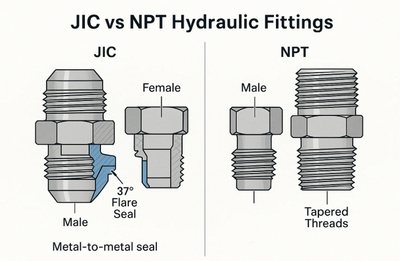
Hydraulic fitting standards are easier to compare when grouped by seal location. Threads may wedge and seal, clamp a metal flare, compress an O-ring, hold a cone seat, retain a ferrule, or secure a flange. Two parts with similar thread diameter can fail because their fluid boundaries are different.
Use this map to identify candidates, then confirm exact standard, size, material, rating, and mating part.
Tapered pipe threads seal in the thread joint
NPT under ASME B1.20.1 uses a 60-degree tapered form and normally an approved sealant. NPTF under ASME B1.20.3 is a Dryseal thread with different truncation/tolerance control. They can sometimes engage, but mixed use must be authorized by the equipment specification.
BSPT or R-family threads under ISO 7-1 use a 55-degree Whitworth form. They are not compatible with NPT. Nominal pipe size is not measured OD, and subtracting a fixed fraction from diameter is not a reliable identification rule.
Mechanical pipe swivels seal at a seat
NPSM uses straight pipe-family threads in mechanical connections, commonly female hose swivels with an internal cone. The thread retains the joint while the intended male nose and female seat seal.
A part may thread onto another pipe end without matching the seat. Verify straight/tapered form, pitch, cone, and documented mate.
SAE line connections use flares or faces
JIC under SAE J514 uses straight UN/UNF threads to clamp a 37-degree metal flare. SAE 45-degree flare and many 30-degree systems are not interchangeable.
ORFS under SAE J1453 seals with an O-ring in a flat male face. The female swivel presents a matching flat. Keep the face clean and use the specified O-ring; pipe tape on the straight thread is not the seal.
AN connections can share 37-degree geometry but belong to aerospace specifications and should not be replaced by industrial JIC based on angle alone.
Port connections use O-rings at the component body
ORB under SAE J1926 uses a straight UN/UNF stud and an O-ring at the port chamfer. ISO 6149 uses metric straight threads and an O-ring port concept. Their threads, dimensions, and callouts differ.
Adjustable elbows and tees use a locknut and washer arrangement for orientation. The port surface, O-ring compound, groove, and installation procedure are part of the seal.
BSP and metric families require exact suffixes
ISO 228-1 G/BSPP threads are parallel and seal through a bonded washer, O-ring, cone, or other external feature. External G threads can specify tolerance Class A or B; internal G has one class.
DIN/ISO metric systems include 24-degree bite-type and O-ring cone connections, metric ports, and other designs. A “DIN” label does not identify tube series, thread, seat, or seal.
Japanese equipment can use JIS 30-degree flare with BSP-family threads, metric Komatsu-style ends, tapered pipe threads, and flanges. Do not describe all JIS as one metric connection or assume direct BSP interchangeability without the relevant standard.
Flanges and ferrules create other boundaries
SAE J518/ISO 6162 four-bolt flanges use a flanged head, clamp halves, bolts, and O-ring. Code/series, size, face, groove, clamp, bolt, and pressure class must match.
Single- and double-ferrule instrumentation fittings grip and seal prepared tubing under a manufacturer-controlled assembly. Tube OD, wall, hardness, material, surface, ferrules, nut, and body must be compatible. Ferrule parts should not be mixed casually across systems.
Identification closes with both halves
Clean the end, determine gender, measure diameter and pitch, check taper, gauge the seat or face, inspect O-rings or ferrules, and compare with drawings. Record the opposite connection and equipment context.
Material and pressure come after geometry: carbon steel, stainless, brass, and other alloys do not make mismatched standards safe.
A buyer’s map is useful because it directs attention to the fluid boundary. A complete purchase description states the standard, size, gender, seal, body shape, material, opposite end, and service—far more than “hydraulic adapter.”