
Build Hydraulic Contamination Control Around Representative Samples
HGW Hydraulics on Apr 8th 2026
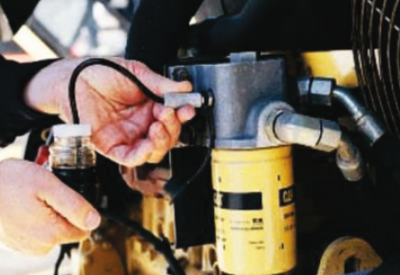
Contamination control fails when a laboratory number is treated as the entire program. The result is meaningful only if the sample represents the operating fluid, the target fits the most sensitive component, and a defined response follows an out-of-limit result.
Particles, water, air, degraded additives, wear metals, and process fluids require different detection and treatment. A strong program starts before new oil enters the reservoir and continues through maintenance, sampling, filtration, and disposal.
Define the cleanliness target from the equipment
Use the machine, pump, valve, servo, bearing, and fluid supplier requirements to set targets. The most contamination-sensitive component may control the acceptable particulate level. Water and chemical limits can depend on fluid type and materials.
Do not copy one ISO cleanliness code to every system. Record the coding standard and edition, particle-count method, sampling point, operating condition, and laboratory reporting units so later results can be compared correctly.
Critical systems may need action and alarm limits, not one pass/fail line. Trending can reveal deterioration before a sample crosses the final limit.
Make the sample represent circulating fluid
An operating main-flow line is often a stronger sampling location than the top of a quiet reservoir because it can capture fluid actually moving through the system. ISO 4021 addresses extraction of samples from operating lines; a new revision is under development, so the current controlled procedure should be identified rather than assumed.
Select a turbulent, well-mixed point that is safe to access and is not immediately downstream of an unrepresentative disturbance unless that location is intentional. Flush the sampling hardware as specified. Use a clean container and prevent dust, water, or residue from the port and cap entering the bottle.
A test point allows a sample or pressure measurement without opening a large connection, but it must be rated for the system, maintained clean, and used with compatible hoses and adapters. Sampling at working pressure requires trained personnel and a controlled method.
New fluid and new components are possible inputs
New oil is not automatically clean enough for a sensitive hydraulic system. Storage tank condition, transfer hoses, drums, funnels, breathers, and filling practices can add contamination. Filter the incoming fluid when the equipment program requires it and verify the transfer equipment’s cleanliness.
Hoses, tubes, manifolds, and replacement components can retain cutting debris, elastomer particles, preservative, or cleaning residue. Keep ports capped and verify assembly cleanliness to the applicable specification. ISO/TS 18409:2018 describes sample collection methods for assessing solid particulate contamination in many hose assemblies; it does not cover every liquid or grease contaminant.
After intrusive work, sample at a time and point that can reveal whether the system was exposed, while recognizing that an immediate isolated bottle may not yet represent full circulation.
Choose the test for the suspected contaminant
Automatic particle counting can quantify solid particles within the method’s scope. Gravimetric analysis measures collected contaminant mass and may be useful for heavier contamination. Water can require Karl Fischer or another appropriate method. Viscosity, acid number, elemental analysis, membrane examination, and ferrography answer other questions.
Light-extinction particle counting can be affected by water droplets or other non-solid material in a non-single-phase sample. The laboratory should know the fluid and suspected condition before choosing preparation and interpretation.
Visual appearance and a magnetic plug are useful observations but cannot replace a representative, calibrated analysis where limits matter.
Filters are selected by performance and circuit location
A filter’s nominal micron label does not fully describe capture efficiency, dirt capacity, pressure drop, collapse resistance, fatigue behavior, or bypass setting. Match the element and housing to flow, viscosity, temperature, pressure, contamination target, and component sensitivity.
Pressure-line, return-line, offline kidney-loop, suction, and breather filtration serve different purposes. Very restrictive suction filtration can harm pump inlet conditions. A bypass filter can clean a portion of flow continuously but does not correct dirt entering through open reservoirs, damaged seals, or poor maintenance.
Monitor differential pressure under comparable flow and temperature. Changing an element only by calendar can waste capacity or allow an early-loaded filter to remain in service.
Control water and air as separate pathways
Desiccant breathers can reduce moisture and airborne particle entry when correctly sized, installed, and replaced, but they do not remove all water already in the oil. Shaft seals, coolers, washdown, condensation, and open hatches remain possible paths.
Foam and entrained air can make controls unstable and complicate particle readings. Inspect reservoir level, return entry, suction connections, and deaeration before treating an air problem as solid dirt.
Rust inhibitors are part of an approved fluid formulation, not a field substitute for removing water or correcting corrosion exposure. Avoid mixing additives without fluid-supplier approval.
Close the loop after an abnormal result
Confirm sample identity and handling, then repeat when evidence suggests a sampling error. If the result is real, isolate likely entry paths, assess component condition, and select filtration, dehydration, flushing, or fluid replacement based on the contaminant and severity.
Record the source, affected equipment, corrective action, filter changes, fluid added, and follow-up sample. A return to target under the same operating and sampling condition verifies that the response worked.
Contamination control protects uptime when it links a representative sample to a specific target and a traceable action. Filters, breathers, test points, clean components, and laboratory methods are tools inside that loop, not independent guarantees.