
Investigating Hydraulic Hose Damage Before Selecting a Guard or Sleeve
HGW Hydraulics on Feb 26th 2026
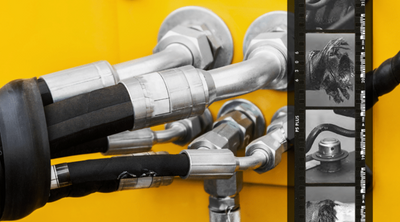
A burst hose and a worn outer cover are end conditions, not root causes. Installing a sleeve over the replacement may be appropriate, but it will not correct excessive pressure, a tight bend, incompatible fluid, a damaged fitting, or a route that forces the hose across a sharp edge.
A defensible repair begins with evidence from the failed assembly and its installation. Preserve that evidence long enough to identify where damage started.
Read the failure location before discarding the hose
A rupture near the fitting may point to excessive bend, hose twist, incorrect insertion, assembly damage, or concentration of flex at the coupling. A failure in the middle of a run can be associated with abrasion, crushing, impact, heat, aging, or a localized defect. Multiple cover rubs often reveal movement between hoses or against a machine structure.
Photograph the assembly in place when safe, mark orientation and routing, and record machine function, operating hours, fluid, temperature, recent repairs, and the event that exposed the failure. Do not cut away the coupling before the hose manufacturer or assembler has inspected it if a formal investigation is needed.
A burst can begin with pressure, temperature, or assembly error
The replacement assembly must have a working-pressure and temperature range suitable for the complete circuit, including transients and fluid compatibility. Relief-valve setting alone does not describe every pressure spike. Fast valve shifts, trapped fluid, thermal expansion, or load-induced pressure can create different conditions.
Extreme heat accelerates hose aging and can reduce material capability. Cold can increase stiffness and make a tight bend more damaging. An incompatible fluid or cleaning chemical can soften, harden, swell, or extract compounds from the tube or cover.
Fittings and hose must belong to a qualified assembly system and be installed with the correct tooling and procedure. A visually compatible stem or ferrule is not evidence of compatibility.
Abrasion progresses from the cover toward reinforcement
The cover protects the reinforcement from mechanical damage and environment. Repeated rubbing can polish, score, or remove it, exposing wire or textile reinforcement to further wear and corrosion. Pressure cycling can make a hose change length slightly, so a stationary-looking contact point may still abrade.
Find what moves relative to what. Inspect adjacent hoses, brackets, clamps, guards, sheet-metal edges, and accumulated debris. A protective sleeve can also wear through if it is trapped against the same sharp surface. Rerouting or adding a smooth support may be more important than choosing a thicker cover.
Select protection by hazard, not one product claim
Textile sleeves can reduce hose-to-hose abrasion and may help contain or diffuse escaping fluid when specifically designed and qualified for that purpose. Spiral guards resist localized rubbing and impact while permitting flexibility. Spring guards or bend restrictors can support a vulnerable bend near a coupling. Rigid shields can separate personnel or components from a hazard.
Confirm the guard’s temperature, fluid and environmental compatibility, abrasion method, burst-containment purpose, fastening, coverage, and inspection interval. Protection must not hide a leak indefinitely, trap damaging contamination, or force a hose below its minimum bend radius.
A sleeve does not raise the hose assembly’s pressure rating. Product-specific test data should be used instead of transferring a pressure, pinhole, temperature, or abrasion-cycle claim from another design.
Apply current standards with the machine context
ISO 3457:2003 addresses guards and other means of protecting personnel from mechanical, fluid, and thermal hazards on earth-moving machinery and was confirmed as current in 2024. Exact machine requirements must be taken from the applicable standard text, equipment design, risk assessment, and manufacturer instructions rather than a copied threshold in a marketing article.
The older ISO 6945 abrasion test is withdrawn. ISO/TS 20444:2024 now specifies a comparison method for outer-cover abrasion for hoses within its stated scope; ISO notes that the method is not intended to predict service abrasion life. Test cycles are therefore not a promise of hours on a machine.
Other industries and equipment types may be governed by different standards. Identify the machine, jurisdiction, and intended protective function before citing compliance.
Pressure injection is a medical emergency
Escaping hydraulic fluid can penetrate skin through a small pinhole. The wound may initially appear minor even though internal damage is severe. Never use a hand or body part to locate a leak. Isolate pressure and use the machine’s approved detection procedure.
If injection is suspected, obtain emergency medical treatment immediately and provide information about the fluid. Do not delay because pain or visible damage seems limited.
Before replacing a hose, lower or mechanically support raised equipment, shut down the energy source, discharge accumulators and trapped pressure as instructed, and verify the circuit is in a safe state.
Verify routing through the entire motion cycle
Match hose type, size, ends, orientation, length, and protection to the approved specification. An assembly that is too short loads the fittings; one that is too long can snag or rub. Remove twist by aligning the lay line and end orientation during installation.
With the machine safely controlled, examine the route through its permitted motion. Maintain clearance from heat, sharp edges, pinch points, tires, tracks, and articulated joints. Position clamps so they support rather than crush the hose and do not concentrate bending at the coupling.
Turn the failure into a controlled maintenance change
After the repair, record the cause, corrective action, replacement identity, date, and inspection point. If several machines share the same route, inspect the population and confirm whether the problem is isolated or systematic.
Monitor the replacement early enough to see whether contact, heat, or movement remains. A clean, undamaged sleeve at the first inspection is evidence that the change is working; it is not a reason to stop future inspections.
Hydraulic hose protection works best after the failure mechanism is understood. Pressure control, compatible materials, qualified assembly, correct routing, guarding, and inspection must support each other. Otherwise a new sleeve can merely conceal the same path to the next failure.