
Why Tightening a Live Hydraulic Leak Is Not a Maintenance Shortcut
HGW Hydraulics on Nov 21st 2024
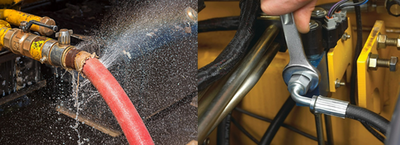
A leaking hydraulic connector creates pressure to restore production quickly. Tightening it while the machine remains energized may seem efficient because the technician can watch for the drip to stop. That shortcut places a person beside a loaded component at the exact moment additional wrench force is applied.
The safer process isolates energy, establishes stable access, diagnoses the connection, replaces damaged parts, and tests only after personnel have returned to a protected position.
A small seep can conceal stored energy
Hydraulic systems can retain pressure after a pump stops. Accumulators, cylinders under load, trapped lines, gravity, thermal expansion, and mechanically loaded actuators can all restore fluid force. A gauge at one point may not prove every branch is at atmospheric pressure.
High-pressure fluid released through a pinhole can penetrate skin. A fitting or wrench can also become a projectile if threads, tube, or body fail. Hot or chemically hazardous fluid adds burn and exposure risk.
Never use a hand—even inside a glove—to locate a leak. Injection injuries require immediate emergency medical treatment.
Working at height multiplies the consequence
A technician reacting to a sudden fluid jet can lose balance even when the release does not directly injure them. A stepladder provides little fall protection or room to manage tools and hoses. Use the site-approved work platform, guardrails or fall restraint, access planning, and exclusion zone for elevated maintenance.
Stable access does not make a pressurized repair acceptable. It is an independent control that addresses the fall hazard after energy has also been isolated.
More torque can be the final load a damaged part carries
A connection that begins leaking after service may already have cracked, loosened under side load, galled, corroded, or been overtightened previously. Tapered pipe threads expand a female port as they advance; extra tightening can split a weakened boss. A flare or O-ring connection can be damaged when torque is used to correct a wrong seal.
A torque wrench is useful only with a product-specific procedure and a serviceable component. Reaching a torque number cannot certify threads whose history and condition are unknown.
The safe repair cycle is deliberate
First, stop the equipment under the normal procedure and apply required lockout/tagout. Block or lower suspended loads, isolate accumulators, and relieve pressure through approved paths. Verify the zero-energy state with appropriate instruments and procedures.
Second, clean and trace the actual leak source. Fluid may have traveled from a hose, crimp, valve, port, or connection above the drip. Identify the fitting family and sealing surface before disassembly.
Third, inspect threads, seats, O-rings, tube flare, hose routing, clamps, and port condition. Replace a suspect connector rather than repeatedly tightening it. Use the specified seal, compatible compound, and correct fitting standard.
Fourth, restore guards and clear personnel. Re-energize gradually for a controlled leak and function test. If the joint still leaks, isolate and depressurize again before any adjustment. Repeated safe cycles take longer than live tightening but prevent exposure during wrench work.
Training turns the procedure into a habit
Hydraulic technicians need training in stored energy, lockout, fluid injection, connection identification, safe leak detection, torque procedures, access equipment, and emergency response. Supervisors must allow enough downtime to use those controls.
Maintenance records should capture the failed component, root cause, repair, and test. Repeated leaks at one location may indicate routing, vibration, contamination, or port damage that a new fitting alone will not solve.
The correct response to a live leak is not to become faster with a wrench. It is to remove the energy that can turn a routine connector into an injection, rupture, or fall incident, then return the circuit to service through a controlled repair and test.