
Reading a Hydraulic Schematic by Supply, Control, Work, and Return Paths
HGW Hydraulics on Aug 12th 2025
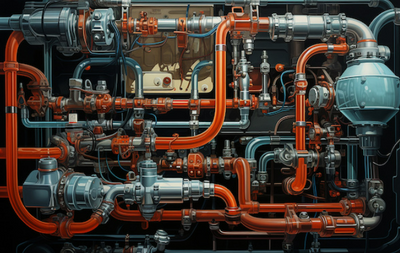
A hydraulic component makes sense only in its path. The same line symbol can carry pump supply, actuator return, pilot pressure, case leakage, load-sensing signal, drain flow, or tank connection. Combining them casually can create backpressure, overheating, unstable control, or component damage.
Reading the schematic from energy source to return separates these functions.
Supply begins at reservoir and pump inlet
The reservoir stores and conditions fluid. Suction plumbing, shutoff valves, strainers where specified, level, breather, and fluid viscosity affect pump inlet pressure. A restricted inlet can cavitate a pump before the high-pressure circuit is involved.
The prime mover drives a gear, vane, piston, or other pump. Fixed and variable-displacement pumps need different controls and protection. The pump produces flow; load and restrictions develop pressure.
Pressure controls limit and sequence load
Relief valves limit maximum pressure. Reducing valves maintain lower pressure in a branch. Sequence, counterbalance, brake, unloading, and load-holding valves perform different functions and should not be interchanged by port size.
Pilot and drain connections influence settings. A pressure-control valve can behave incorrectly if its drain sees unexpected backpressure or its remote pilot is blocked.
Directional and flow valves determine motion
Directional valves connect pressure, actuator, and tank paths in commanded positions. Center condition defines what happens when no motion is requested. Solenoid, manual, hydraulic, pneumatic, proportional, and servo actuation add different control needs.
Flow controls regulate actuator speed by creating a controlled restriction or compensating for pressure changes. Meter-in, meter-out, and bypass arrangements respond differently to overrunning loads.
Actuators perform work and can store energy
Cylinders create linear motion; motors create rotary motion. Load, area or displacement, efficiency, leakage, inertia, and pressure determine output. Accumulators store hydraulic energy for emergency movement, peak flow, shock control, or pulsation damping.
Raised cylinders and charged accumulators remain hazardous after the pump stops. Schematic isolation and bleed features must be reflected in maintenance procedures.
Case drains are not ordinary returns
Many piston pumps and motors use a case-drain line to carry internal leakage, lubricate/cool the case, and control housing pressure. It normally requires low backpressure, correct routing, and sufficient size under manufacturer instructions.
Do not plug, tee into a high-backpressure return, or route below/above reservoir level without reviewing the component requirements. Excess case pressure can damage shaft seals or internal parts.
Return, filtration, and cooling close the circuit
Return lines carry actuator and valve flow back to the reservoir or closed-circuit path. Backpressure affects valves, motors, seals, and cylinder behavior. Filters can be placed in pressure, return, offline, or other locations according to component sensitivity and circuit goals.
Coolers remove heat generated by losses. Bypass, thermostat, contamination indicator, and cold-start viscosity need consideration. A clogged filter or cooler is not solved by permanently removing the element.
Connections preserve each path’s requirement
Line size, hose/tube construction, fitting standard, pressure-temperature rating, material, and route follow the function. A case drain may have low nominal pressure but critical low-backpressure and cleanliness requirements. A pump outlet sees high pressure and impulse.
Use labels, test points, and as-built schematics. Before service, lock out, support loads, isolate accumulators, and verify pressure relief. Never use a hand to search for leakage.
Tracing supply, control, work, drain, and return paths turns a component list into an operating system. It also prevents a convenient hose connection from silently changing the pressure or contamination conditions a component depends on.