
Identify BSP and NPT by Thread Form, Taper, and Seal Location
HGW Hydraulics on Sep 30th 2021
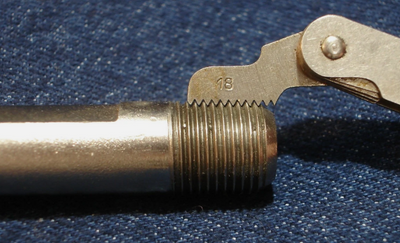
BSP and NPT pipe threads can look close enough to start together, yet their geometry and sealing arrangements are not a valid mixed pair. Identification should explain both how the parts retain and where the pressure boundary forms.
The equipment's country is only a clue. Repairs and conversion adapters may have changed the visible connection.
First decide whether the thread tapers
NPT is a tapered U.S. pipe-thread family. BSPT also tapers, while BSPP is parallel. Compare diameter at separated thread locations or use the appropriate gauge and reference table; visual judgment alone is unreliable on a short male thread.
A parallel female swivel or port may still have a conical nose, washer, O-ring or bonded seal. Do not classify it as tapered because the assembly becomes tight at the sealing face.
Use pitch and form together
NPT uses a 60-degree thread form. BSP is based on a 55-degree Whitworth form with different crest and root geometry. Pitch relationships also differ across many nominal sizes.
Measure outside diameter with calipers and pitch with a thread gauge, then compare both to a dimensional table. Pipe nominal size is not the measured outside diameter, so a direct ruler conversion can select the wrong part.
A gauge leaf fitting between threads supports pitch identification; it does not by itself prove standard, taper or sealing style.
Find the actual pressure boundary
Correctly assembled tapered pipe threads use specified interference and a sealant practice suitable for the fluid and equipment. Thread form, engagement, port material and sealant all affect the joint.
BSPP commonly uses another sealing feature: a bonded washer under a stud, an O-ring at a port, or a cone seat in a swivel. Parallel retaining threads should not be treated as NPT and packed with extra sealant to compensate.
Inspect the female half for a spotface, chamfer, cone or damaged washer surface. Old sealant inside a port can hide the geometry and contaminate the system.
Reject the near-match test
An NPT male may turn into some BSP components, and a BSP part may begin in an NPT port. The mismatch can damage both components, jam before correct engagement or leave a helical leak path.
Start a known-correct connection by hand without force. Unexpected resistance is a reason to stop and remeasure, not to use a longer wrench. Never use successful thread engagement as the identification method.
Install by the governing product method
Clean and inspect both threads. Apply only the approved sealant in the correct location, keeping excess material out of the fluid path. Tighten by the fitting, port and sealant instructions rather than a universal number of turns.
Shaped tapered fittings create an orientation problem. Backing off an elbow to point it in the desired direction can disturb the seal. Use an adjustable stud, swivel or suitable adapter when final orientation cannot be reached within the permitted engagement.
For metal or plastic female ports, excessive torque can split or deform the component. A leak after correct installation calls for inspection of thread damage, cracks and sealing surfaces rather than repeated tightening.
Describe conversion adapters end by end
A replacement may join BSP to JIC, ORFS, ORB, NPT, metric, hose or tube. Record both ends, gender, size, thread, seat or seal, body shape and material. “BSP adapter” is not enough when BSPP and BSPT use different functions.
Photograph the connection face-on and beside a scale, and note the equipment location. Reliable identification is the combined result of taper, diameter, pitch, thread form and seal location—not a regional guess.