
Identify Japanese Hydraulic Threads Without Using the OEM Name as a Gauge
HGW Hydraulics on Feb 9th 2022
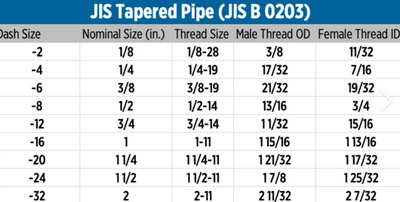
“Japanese fitting” can describe several connections. JIS designs may use BSPP-based parallel threads and a 30-degree seat, tapered pipe threads, metric threads, or OEM-specific geometry. Machine brand helps locate documentation but does not identify the seal.
JIS 30-degree ends require seat confirmation
Some JIS hose adapters use BSPP threads with a 30-degree flare seat. The seat, not the parallel thread, creates the primary seal. A British BSPP connection can use another cone, washer, or O-ring arrangement and is not automatically interchangeable.
Gauge the seat angle and inspect male/female orientation. “Inverted flare” language varies, so use drawings and dimensions rather than the label.
Japanese tapered threads are a separate path
Where the connection is tapered, determine the applicable JIS/BSPT-related form, pitch, taper, and sealant procedure. Do not apply parallel-seat rules or infer the thread from a flat end face.
Komatsu is not one universal fitting
Komatsu equipment can contain metric 30-degree connections, flange interfaces, BSP/JIS-related ends, and other configurations depending on model, serial range, and function. The source’s claim that all equipment uses one coupling is too broad.
Record machine model, serial number, location, thread major diameter, metric pitch or TPI, taper, seat angle, tube/hose size, seal, and opposite end. Match them to an OEM drawing or verified part.
Flanges need complete dimensional checks
Komatsu-style flange heads may resemble SAE Code 61 or Code 62 but can differ in head thickness, bolt pattern, O-ring, and rating. Do not choose from four bolt holes alone.
For mixed fleets, store verified JIS, Komatsu, BSP, and metric parts separately. A documented sample and drawing are stronger than an OEM name written on a bin.