
Verify a JIC Connection at the 37 Degree Seat, Not Only the Thread
Mar 2nd 2023
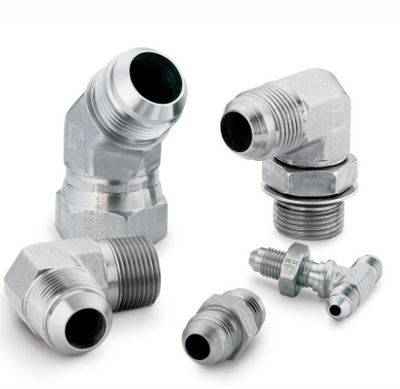
A JIC connection seals where two 37-degree metal surfaces meet. The straight threads draw those seats together but do not seal pressure. That division explains both the connection’s serviceability and its most common identification error: a different fitting can share or nearly match the thread while presenting the wrong seat.
Inspect the complete male and female interface
On a male JIC end, identify the external straight thread and convex 37-degree cone. The female hose or tube end provides the mating flare seat and a nut that supplies clamp load. Confirm nominal tube or dash size, actual thread diameter and pitch, seat angle, and body style.
SAE J514 is a principal reference for 37-degree flared hydraulic tube fittings. The finished adapter or hose end still needs a documented working rating for its size, material, and temperature. A standard name by itself is not a universal pressure value.
Separate similar flare families before assembly
AN connections also use 37-degree flare geometry and related straight-thread sizes, but procurement requirements, materials, tolerances, qualification, and application approvals may differ. A proposed AN-to-JIC substitution needs component-level verification rather than a statement that the two names are always equivalent.
SAE 45-degree flare fittings may have straight threads that engage a JIC part at some sizes. The 45-degree and 37-degree seats do not mate correctly. Japanese 30-degree flare families and OEM connections can also resemble JIC while using different threads or dimensions. Equipment origin is a clue, not proof.
Use pitch, diameter, and seat-angle gauges where identity is uncertain. Do not coat a wrong flare with sealant or an improvised washer. The thread cannot pull two different cones into a reliable engineered seat.
Read leakage patterns at the flare
Radial scratches, dents, embedded debris, corrosion, or a distorted tube flare can interrupt metal contact. Misalignment may leave a witness mark on only part of the circumference. Over-tightening can damage the seat or flare and does not guarantee a better seal.
If a connection leaks, depressurize it and clean the faces for inspection. Check tube support, hose twist, vibration, and side load as well as the fitting. Replacing only the male adapter will not repair a damaged female flare.
Use JIC where its service characteristics fit
JIC adapters are available in many straight, elbow, tee, bulkhead, swivel-nut, and conversion configurations. They are widely used on mobile and industrial hydraulic hose and tube assemblies, which can simplify service and inventory. Carbon steel, stainless steel, brass, and other materials are selected according to the component design and environment.
Metal-to-metal sealing avoids an elastomer at the flare, but it also depends on clean, compatible surfaces. An O-ring face or boss connection may be selected by the equipment designer for different leakage, vibration, assembly, or maintenance goals. No one seal style is automatically best for every circuit.
For purchasing, record JIC designation, dash or tube size, thread, 37-degree seat, male or female end, material, body shape, orientation, rating, and opposite connection. Those details preserve the useful interchangeability of a standardized JIC system without treating every straight-thread flare as the same fitting.