
How JIC 37-Degree Flare Connections Clamp, Seal, and Fail
HGW Hydraulics on Aug 3rd 2023
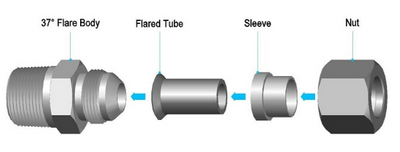
JIC is a widely used industrial hydraulic connection built around a 37-degree metal flare. A straight-thread nut pulls matching male and female seats together; fluid containment occurs at that conical contact rather than in the threads.
This separation makes the joint inspectable and serviceable, but it does not make every 37-degree-looking fitting interchangeable. Standard, size, surface condition, material, and assembly load all have to agree.
SAE J514 defines more than a flare angle
SAE J514 addresses 37-degree flared tube fittings and related dimensional and performance requirements. The connection family traces its common name to the Joint Industry Council and uses unified inch threads paired with defined tube-size relationships.
When the nut is tightened, the threads create axial force. The male cone and female flare make circumferential metal contact. Thread sealant is not part of a normal JIC seal and should not be used to mask a scarred or mismatched seat.
Older military specifications and other 37-degree systems may have different requirements. A shared angle alone does not authorize substitution into aerospace or controlled-service assemblies.
Dash size links the connection to tube OD
JIC dash numbers commonly represent nominal tube outside diameter in sixteenths of an inch. Thus -4 relates to 1/4-inch tube, -6 to 3/8, -8 to 1/2, -12 to 3/4, and -16 to 1 inch.
Each dash size pairs with a specified UN/UNF thread. Examples include 7/16-20 at -4, 9/16-18 at -6, 3/4-16 at -8, and 1-1/16-12 at -12. Use the current standard or a reliable chart for exact values; the thread OD is not the tube OD.
Identification should combine caliper measurement, pitch gauge, straight-thread confirmation, 37-degree seat inspection, and the mating part. Wrench size and approximate outside diameter are not adequate.
Applications benefit from a visible metal seat
JIC connections are common on construction and agricultural machinery, industrial hydraulic power units, mobile equipment, test systems, tube runs, and hose adapters. Availability and the ability to disconnect and inspect the flare support maintenance across many fleets.
The metal seal avoids elastomer compatibility at the flare itself. Other seals may still exist elsewhere in the system. Temperature, corrosion, pressure cycles, vibration, tube preparation, and hose routing remain relevant to the complete assembly.
No universal pressure rating belongs to the word JIC. Size, material, body shape, wall thickness, tube, hose, and manufacturer data determine limits.
Material choice does not fix bad geometry
Carbon steel with a suitable finish serves many hydraulic systems. Stainless steel can improve resistance in compatible corrosive environments, while brass and other alloys have their own uses. Stainless threads and seats require care to avoid galling and damage.
Material certificates may be required for controlled purchasing, but a correct alloy cannot compensate for a 45-degree seat, wrong pitch, or distorted tube flare. Define the applicable standard, material grade, and documentation separately.
Installation quality appears on the flare
Inspect both seats for radial scratches, dents, corrosion, contamination, and uneven contact. Align tube or hose without side load and start the nut by hand. Tighten using the fitting or equipment manufacturer’s method, supporting the body with a backup wrench where required.
Overtightening can deform the flare, crack a thin tube, or damage the cone. Undertightening can leave incomplete contact. Reuse is conditional on inspection; a polished ring may be normal witness evidence, while a gouge or offset ring indicates a problem.
A leak after service may also originate at a nearby crimp or port and travel to the nut. Clean and observe under a safe test procedure before assigning cause.
Similar-looking ends must be excluded
SAE 45-degree flare is not JIC. Many JIS connections use a 30-degree seat and different threads. ORB uses an O-ring at a straight-thread port. BSPP has a 55-degree thread form and can employ a cone or face seal. NPT is tapered.
AN connections also use a 37-degree flare, but specification, material, tolerance, inspection, and application requirements can differ. Use the part required by the design rather than treating JIC as an automatic aerospace substitute.
Preserve the connection as a system
An order should identify dash size, thread, male or female end, tube or hose size, body shape, opposite connection, material, and service requirements. If the part is a hose end, the stem and ferrule must be approved for the exact hose and crimp specification.
JIC remains useful because the sealing principle is direct: straight threads clamp a known 37-degree pair. Reliable service comes from preserving that complete geometry and inspecting the seat, not from assuming every familiar flare belongs to the same family.