
JIC Flare or NPT Pipe Thread: Match the Connection to Its Intended Seal
Aug 30th 2023
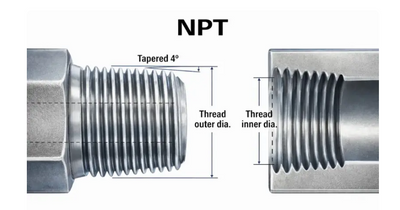
JIC and NPT can appear on opposite sides of the same hydraulic adapter, but they are not direct mates. JIC uses straight threads to clamp a 37-degree metal flare. NPT uses tapered threads and normally an approved sealant to contain fluid along the threaded joint.
The correct selection starts with the existing port or line standard and the service requirements. Pressure alone does not assign one family to every application; actual component ratings and sealing geometry do.
One connection separates thread from seal
SAE J514 JIC fittings use UN/UNF straight threads. The male cone and female flare create the fluid boundary, while the nut provides axial force. Tape or pipe compound on the JIC thread is unnecessary and can conceal a damaged seat.
Dash size commonly corresponds to tube outside diameter in sixteenths of an inch and pairs with a specified thread. For example, -4 commonly uses 7/16-20, -6 uses 9/16-18, and -8 uses 3/4-16. Verify the complete chart for the required size.
A JIC union can be disconnected for inspection, and a swivel nut allows assembly without rotating the line. Cone scratches, distorted flares, misalignment, and side load remain potential leak causes.
The other connection uses a tapered wedge
ASME B1.20.1 NPT threads use a 60-degree form and 1:16 taper on diameter. As the male advances, interference increases. A compatible tape or compound normally fills the spiral path and influences assembly friction.
NPT size is nominal pipe size, not measured thread OD. Common pitches include 27 TPI at 1/8, 18 at 1/4 and 3/8, 14 at 1/2 and 3/4, and 11.5 at larger common sizes. A chart and proper gauges are needed for identification.
NPT can be used in hydraulic and other fluid components specifically designed and rated for it. Its limitations include orientation tied to engagement, possible port expansion, sealant cleanliness, galling, and changing engagement after repeated service.
Partial engagement is a warning, not a conversion
Some JIC and NPT threads have superficially close diameters. A tapered male may start in a straight female or the reverse, but the pitch, taper, and sealing features do not form either intended joint. Turning farther can strip threads, distort a flare, or crack a port.
Use an adapter manufactured with a complete JIC end and complete NPT end. Assemble the 37-degree side clean and without thread sealant; assemble the pipe side with the specified sealing practice. The adapter body also needs suitable pressure, material, temperature, flow, and corrosion capability.
Maintenance objectives influence layout
JIC is useful on serviceable tube and hose lines where the seat can be inspected and parts need repeatable orientation. NPT can provide a compact direct port on existing valves, instruments, reservoirs, and equipment designed around pipe thread.
If a hose needs a JIC swivel but the pump has an NPT port, a short adapter may reduce hose twist and keep pipe-thread engagement at the component. Support the hose so its weight and vibration do not lever the adapter.
ORFS may be considered for a flat O-ring face union, and ORB for a replaceable O-ring port, when the component design permits. NPTF is a related Dryseal pipe-thread standard, not a generic upgrade that can be substituted without reviewing both sides.
Install and troubleshoot by seal location
On JIC, inspect the two flare faces and follow the specified tightening method. On NPT, inspect the tapered threads, apply authorized sealant without blocking the passage, and avoid excessive engagement. Stainless versions require particular galling control under the approved procedure.
A JIC leak generally directs attention to the cone, tube flare, alignment, and nut load. An NPT leak directs attention to thread match, engagement, sealant, galling, and port condition. Fluid can travel from another joint, so clean and locate the origin before disassembly.
Record standard, size, gender, seat, material, opposite end, and equipment location for future purchasing. Do not describe either end only by outside diameter or wrench size.
JIC and NPT each work when the line or port is designed for their sealing method. A deliberate transition adapter lets them coexist without pretending that similar-looking threads are interchangeable.