
JIS and JIC Flare Fittings: Verify the Exact Japanese Connection Before Adapting
Sep 5th 2023
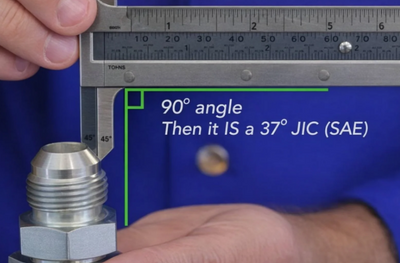
JIC describes a well-known SAE 37-degree flare family. JIS is broader: Japanese equipment can use several connection arrangements defined by different JIS standards, including 30-degree flare ends with BSP-family or metric threads. Calling every Japanese end “metric JIS” can be as misleading as calling it JIC.
A correct replacement identifies the exact thread and seat on the installed part. Regional origin and visual similarity are useful clues, not compatibility evidence.
Establish the SAE reference first
JIC fittings under SAE J514 use a 37-degree male cone and matching female flare with straight UN/UNF threads. Dash size commonly relates to tube outside diameter in sixteenths of an inch. The threads clamp the faces, and the metal flare forms the seal.
This geometry is common on North American and globally supplied hydraulic machinery. It should not be confused with SAE 45-degree flare or assumed to meet aerospace requirements merely because another connection also uses 37 degrees.
Treat “JIS” as a prompt for another question
JIS B8363 30-degree flare connections commonly encountered on Japanese hydraulic equipment can use BSPP-family threads. Other Japanese/OEM connections, including Komatsu-style ends, may pair a metric pitch with their own 30-degree sealing cone. Equipment documentation and the referenced standard determine which arrangement is present.
This is why a universal JIS thread-size table can create wrong orders. The buyer must record whether the thread is metric or BSP-family, its pitch, the seat angle, nominal tube or hose relationship, and the intended mate.
JIS connections are found on Japanese and other Asian excavators, forklifts, machine tools, injection equipment, factory automation, and replacement hose assemblies. An OEM may use multiple standards on one machine.
The flare mismatch remains critical
A 30-degree seat and 37-degree cone do not create the designed area of contact. They may touch along a narrow ring, producing high local stress and a leakage path. More torque can deform the softer surface without correcting the angles.
Thread mismatch can fail even earlier. A BSPP or metric thread may start in an inch UN/UNF counterpart but bind as pitch error accumulates. Conversely, some measured diameters can appear close while the seat behind them is entirely different.
Material or certification does not correct either mismatch. Stainless steel of the specified grade may address corrosion needs, but an alloy certificate cannot turn a 30-degree seat into a 37-degree one.
Identify an unknown fitting in a fixed order
Clean the component and determine male or female end. Inspect and gauge the seat angle. Check whether the thread is straight or tapered, then measure diameter and pitch. Use both inch and metric pitch gauges and compare the results with the relevant JIS, SAE, or OEM drawing.
Look for markings and equipment part numbers, but verify them against the actual geometry. Photograph the disconnected male and female sides beside a scale. If possible, keep the original mating pair rather than identifying one half alone.
Do not use thread engagement as a field gauge. A wrong part can damage the only sample and make subsequent measurement less reliable.
Adapters should preserve both named standards
Mixed fleets and retrofits may require a JIS-to-JIC adapter. Its Japanese side must state the exact thread and 30-degree connection; its JIC side must provide the specified 37-degree SAE end. A label that says only “JIS to JIC” leaves too much unresolved.
Check body length, male/female orientation, hose clearance, tube or hose size, material, pressure and temperature requirements, and service access. Each adapter adds two seal boundaries and leverage, so one defined transition is preferable to a stack of approximate converters.
For hose replacement, match the stem and ferrule to the hose construction and crimp data as well as matching the external fitting end.
Choose by the machine, not by a regional ranking
Neither JIS nor JIC is universally better. The correct standard is the one designed into the equipment or deliberately converted through an approved interface. Pressure and vibration capability come from the exact part and assembly, not a general claim that one regional family is stronger.
Store Japanese, JIC, BSP, and metric look-alikes in clearly separated bins and retain measurement records for recurring equipment. That small control prevents a familiar-looking end from becoming the next emergency replacement.
JIS-versus-JIC selection becomes reliable when “JIS” is expanded into its precise thread and seat definition. Once the 30- or 37-degree flare, pitch, diameter, and mating standard are known, the correct fitting or adapter can be specified without guesswork.