
Finding a Hydraulic Leak Safely Before Replacing the Fitting
HGW Hydraulics on Mar 14th 2024
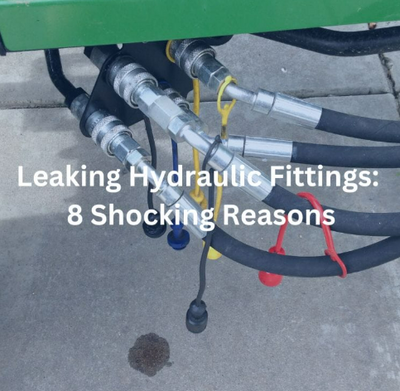
Fluid collecting on a fitting does not prove the fitting is the source. Oil can travel along a hose, tube, adapter, or machine surface before dripping at the lowest point. Replacing the visible part without tracing the leak can add downtime while leaving the original failure untouched.
Diagnosis begins with safety and energy isolation. High-pressure fluid can penetrate skin, and a stopped machine can retain pressure in accumulators, cylinders, trapped lines, and thermally loaded circuits.
Establish a safe condition before inspection
Follow the equipment’s lockout, blocking, and stored-energy procedure. Lower or mechanically support raised loads, shut down power, isolate accumulators, and relieve trapped pressure through the approved path. Confirm the state rather than assuming an idle pump means zero pressure.
Wear the required personal protective equipment and control spills. Never use bare or gloved hands to search for a pinhole. Hydraulic injection can look like a small puncture while causing severe internal injury; it requires immediate emergency medical care.
Leak-detection methods must be suitable for the system and pressure. Use guarded observation, clean paper or cardboard at a safe distance when approved, UV dye compatible with the fluid where permitted, or professional diagnostic equipment.
Clean first, then trace upward
Remove existing oil and dirt under the safe maintenance procedure. Inspect above and around the wet location: hose cover, crimp, tube, valve body, port, adapter interfaces, and nearby seals. Restore only the controlled pressure needed for the authorized test and observe where fresh fluid first appears.
A crimp leak may travel to a JIC nut. A port seal can wet an adapter thread. A cracked component can release fluid only when loaded. Record the first wet boundary before depressurizing again.
Contamination can enter where fluid escapes, so an active leak is also a cleanliness problem. Cap open lines and prevent dirt from entering during repair.
Identify the connection before turning it
Determine whether the joint is JIC, ORFS, ORB, NPT, BSP, metric, flange, hose crimp, or another standard. The repair depends on where that family seals.
ORFS directs inspection to the flat faces and face O-ring. ORB uses an O-ring at the port chamfer. JIC seals on the 37-degree cone. NPT seals in tapered threads with the specified compound. A flange uses its defined O-ring and clamp/bolt arrangement.
Tape on a straight flare or O-ring thread does not repair the intended seal. Extra torque can distort a flare, cut an O-ring, gall threads, or crack a port.
Read the failure evidence after disassembly
Under zero energy, inspect metal seats for scratches, dents, corrosion, and uneven witness marks. Check O-rings for cuts, flattening, extrusion, swelling, hardening, and correct size. Examine threads for cross-threading, pulling, galling, and contamination.
Inspect hose length and routing. A short hose, tight bend, missing clamp, twist, abrasion point, or moving component can load the fitting until a new seal leaks again. Verify that the line is not being used to support a valve or heavy adapter stack.
Reuse is not determined only by connection family. Manufacturer instructions, surface condition, material, thread engagement, and safety requirements control. Replace damaged parts rather than reshaping them with additional tightening.
Install a defined repair
Use the correct replacement fitting, seal compound, hose assembly components, and approved lubricant or sealant. Start threads by hand, align the connection without force, and follow the equipment or fitting manufacturer’s tightening method. A torque wrench is useful only when the specified torque procedure applies to that exact joint and condition.
Replace seals with verified size and material. Do not substitute an O-ring because it fits the groove visually. For tapered threads, apply compatible sealant without blocking the passage.
Verify the circuit, not just the new part
Restore the system gradually under the safe test procedure. Inspect the repaired boundary and adjacent connections through normal motion and operating conditions as required. Confirm clamps, guards, hose clearance, and fluid level. Clean residual oil so a later inspection can distinguish a new leak.
Document the failed location, root cause, parts used, connection standard, and test result. A record can reveal repeated routing or contamination problems across similar machines.
The fastest lasting hydraulic leak repair is often the one that spends more time proving the source. Safe isolation, connection identification, evidence-based replacement, and controlled verification prevent a wet fitting from becoming a repeated guess.