
Evaluate a Brass-to-Stainless Joint by Electrolyte, Area Ratio, and Alloy
HGW Hydraulics on Mar 27th 2024
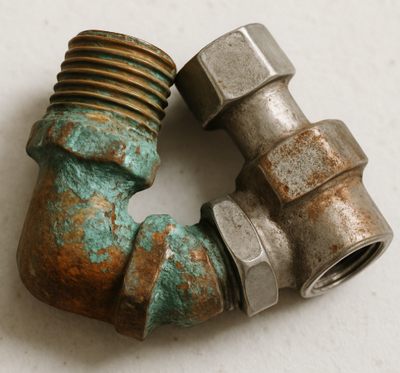
Brass and stainless steel can be connected in some fluid systems, but the joint cannot be approved from a short anodic-index distance alone. Galvanic corrosion requires electrical contact, an electrolyte and a potential difference, while geometry and environment determine the rate.
The exact brass and stainless grades matter as much as their family names.
Map the galvanic cell
Identify which metals are electrically continuous and which surfaces contact water, salt solution, condensate or another conductive fluid. A dry interior gas joint may behave differently from an externally wet marine connection.
Potential tables depend on the reference environment and material condition. A fixed 0.15- or 0.25-volt rule is not universal across fresh water, seawater and industrial chemicals.
Area ratio matters: a small anodic area coupled to a large cathodic area can concentrate attack. Threads and crevices can also retain electrolyte after the outside looks dry.
Specify both alloys
Brass composition affects strength, dezincification resistance, lead content and chemical compatibility. Stainless grades differ in structure and passivity; a martensitic grade does not behave like an austenitic 300-series grade.
Do not conclude that all brass pairs safely with 301, 304 or 310 stainless, or that 410 stainless must rust whenever brass is present. Use data for the actual alloys and environment.
316 stainless often offers better chloride pitting resistance than 304 because of its alloying, but it remains vulnerable to crevice conditions and aggressive chloride exposure.
Review media beyond galvanic corrosion
Some waters can cause brass dezincification. Ammonia and selected chemicals can create additional brass risks. Stainless can suffer pitting, crevice attack or stress-corrosion cracking under certain chloride, temperature and stress conditions.
Internal media, cleaning solutions and external washdown should be evaluated separately. A material combination that works in potable water may be wrong for hot chlorides or a chemical process.
Use finished-part ratings
Temperature and pressure limits come from fitting geometry, alloy condition, seal and product qualification. Universal 400- or 1,200-degree-Fahrenheit comparisons ignore loss of material strength, seal limits and application codes.
Cost should be evaluated after compatibility. A less expensive brass conversion can create more maintenance if isolation, coating or drainage is poor.
Control or remove the coupling mechanism
Where practical, choose compatible alloys throughout the wet zone. Otherwise consider an engineered nonconductive break, compatible coating, drainage, environmental barrier or replaceable sacrificial component under a corrosion plan.
Isolation must survive pressure, temperature and assembly without creating a new leak path. Record alloy grades, wetted areas, fluid, exposure and inspection interval.
A brass-to-stainless joint is an environmental design question. The safe conclusion comes from the cell and the finished components, not how many positions separate two generic names on a chart.