
NPSM Hose Ends: Straight Threads, Swivel Seats, and Correct Mating Parts
May 25th 2023
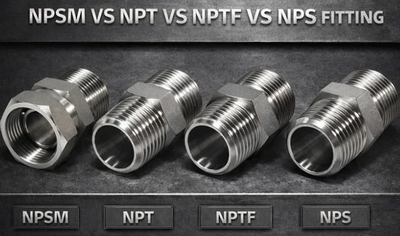
National Pipe Straight Mechanical describes a parallel pipe thread used in a mechanically seated connection. In common hydraulic hose-end arrangements, the straight threads pull a swivel nut onto a compatible male nose while the mating seats form the seal. The threads retain the parts; they are not normally the primary fluid boundary.
This distinction explains two frequent service problems. A straight-thread nut may turn onto a male part whose seat does not match, and an NPSM thread can be mistaken for another parallel standard. Correct replacement therefore requires identification of thread and sealing geometry together.
Follow the seal through a swivel connection
Many female NPSM hose ends use an internal cone seat. Depending on the applicable product standard, a common arrangement mates with a compatible male pipe-style end having the specified cone or chamfer. Tightening the swivel nut brings those metal surfaces together without twisting the hose body.
Descriptions of the seat angle can vary according to whether a catalog states the angle from the fitting axis or the included cone angle. Do not approve compatibility from an angle name in isolation. Compare the actual drawings and intended mating standards.
The swivel is valuable in tight equipment because the nut can rotate independently during installation. It does not correct a side-loaded hose, a scarred seat, or an incorrect counterpart.
Use measurements to narrow the family
NPSM shares nominal pipe-size conventions and pitches with related U.S. pipe threads. Common reference values include 27 threads per inch at nominal 1/8, 18 TPI at 1/4 and 3/8, 14 TPI at 1/2 and 3/4, and 11.5 TPI at larger common sizes. Nominal pipe size is not the measured major diameter.
Measure a clean thread’s major diameter and pitch, then check whether its diameter stays parallel or reduces along the axis. Pitch alone cannot distinguish NPSM from NPT. Finally, inspect the swivel and internal seat and identify the male end intended to contact it.
A chart is useful for screening sizes, but a worn sample or rough caliper measurement is not enough for a purchase decision. Confirm a part number, drawing, or both mating components when possible.
Separate four similar abbreviations
NPT is a 60-degree tapered pipe thread that normally seals through thread interference with approved sealant. NPTF is a controlled Dryseal tapered thread covered by a different specification; assembly and sealant requirements depend on the application and specified parts. NPS is a broader straight pipe-thread designation whose sealing method depends on the particular connection design.
NPSM is also straight, but the “mechanical” designation is a reminder to find the seat. A connection that starts smoothly does not prove that its metal sealing surfaces meet in the correct location.
Some specified female NPSM swivel designs are intended to mate with particular male pipe ends that provide the required cone. That is an engineered pairing, not permission to mix any NPSM and NPT components. Verify the male nose and manufacturer data.
Field identification should include both halves
Clean the fitting and check for these features:
- a parallel thread rather than a diameter that changes along its length;
- a swivel nut that turns independently of the hose stem;
- an internal cone, chamfer, or other defined seating surface;
- thread diameter and pitch matching the documented nominal size;
- a male counterpart with the intended nose and sealing contact.
Compare NPSM with ORB and BSPP as well as NPT. ORB uses a port O-ring and UN/UNF straight thread. BSPP has a 55-degree Whitworth thread form and may seal with a washer, bonded seal, O-ring, or cone according to the connection. Similar outside shapes do not make their sealing parts compatible.
Prevent leaks at the seat
Before assembly, inspect the male and female seats under good light. Radial scratches, dents, corrosion, debris, and uneven old witness marks can prevent contact. Start the nut by hand and support the hose so its bend does not cock the seat.
Thread tape is not a substitute for a matching NPSM seat. Excess tape or paste may enter the hydraulic circuit and can obscure the true cause of leakage. If the applicable procedure calls for a lubricant or sealing product, follow that procedure without transferring an NPT practice to a mechanical-seat joint.
Overtightening can distort the seat or damage the swivel without correcting a mismatch. When leakage persists, depressurize safely, inspect contact marks, remeasure the parts, and confirm the intended mate.
Purchase the complete end configuration
An NPSM replacement record should include nominal thread size, measured pitch, seat type, male or female orientation, swivel construction, hose ID and series, stem and ferrule system, material, media, pressure and temperature requirements, and the connection at the other end of the assembly.
Where the machine port uses another standard, choose a purpose-designed adapter. This preserves the seat on the NPSM side and the correct O-ring, flare, or pipe-thread seal on the port side.
NPSM is straightforward once the seal is visible in the identification process. Treat thread engagement as one check and seat compatibility as a separate, essential check; only their combination defines the usable connection.