
NPSM vs NPT: Mechanical-Seat Swivels and Tapered-Thread Ports
Jun 13th 2023
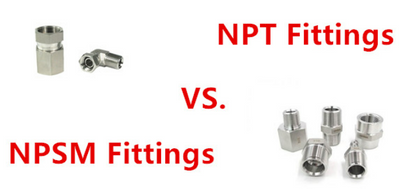
NPSM and NPT can share nominal pipe sizes and thread pitch, yet they solve different connection problems. NPSM uses a straight thread in a mechanically seated arrangement, often a female hose swivel. NPT uses a tapered thread that wedges into a matching port and normally relies on approved sealant.
The decisive question is not whether a nut begins to turn. It is where the finished joint is designed to seal.
Compare the two load paths
In a common NPSM hose end, the swivel nut’s parallel threads pull an internal cone seat against a compatible male nose. The thread provides clamping load while the seat provides metal-to-metal sealing. The nut can rotate without twisting the hose.
In an NPT joint, both parts are tapered. Tightening increases thread interference, and sealant fills the helical path and surface gaps. The fitting body itself normally turns during installation, so final orientation and thread engagement are linked.
This makes NPSM useful for serviceable hose connections and NPT useful for many direct pipe-style ports. Neither description establishes suitability for a particular pressure, fluid, or temperature.
Why some parts engage but still leak
NPSM follows pipe-family diameter and pitch relationships, so a female swivel may appear to fit some male pipe ends. A correct engineered pairing still requires a compatible nose or chamfer. If the seats miss, meet at the wrong line, or use a different angle convention, the joint can leak even when the nut is tight.
Conversely, a straight NPSM thread does not create the increasing wedge expected in an NPT female port. Forcing a tapered male into an unverified straight-thread component can damage threads without establishing the intended seat.
Approve a connection only after checking thread form, pitch, major diameter, male nose, female seat, and the component documentation. Use a purpose-built adapter when the standards do not mate directly.
Installation practices should remain separate
For NPT, clean and inspect the tapered threads, apply the authorized sealant without contaminating the passage, start by hand, and tighten by the specified method. Avoid backing off an elbow after sealing or using extra torque against a cracked or galling port.
For an NPSM swivel, clean and inspect both seats, start the straight thread freely, support the hose, and tighten the nut according to the assembly procedure. Thread tape cannot repair a scarred or mismatched mechanical seat.
Both joints need a safe pressure test. A high-pressure pinhole leak must never be located with a hand. Depressurize before retightening or disassembly.
Maintenance priorities differ
An NPT replacement may tighten at a different depth as threads wear or deform. Old sealant has to be removed without damaging the port or contaminating the circuit. Repeated assembly can reduce available engagement.
An NPSM swivel is convenient to disconnect without rotating the hose, but its cone surfaces are exposed during service. Dents, particles, corrosion, or hose side load can spoil the sealing contact. A nut that turns smoothly is not evidence that the seat remains usable.
In both systems, pressure cycling and vibration must be managed through routing, clamping, and correct component selection. Connection style does not compensate for a hose installed in tension.
Choose from the equipment outward
Keep the port standard already specified by the valve, pump, manifold, or cylinder unless an engineering review authorizes a change. On the hose side, consider whether a swivel improves assembly and service. If the machine has an NPT port but the hose assembly ends in NPSM, a compact adapter may provide the defined male seat and correct NPT end.
Limit stacked adapters. Each extra joint adds length, bending load, inventory complexity, and another potential leak location. Specify material and seal compatibility as well as thread labels.
For purchasing, provide photos or drawings of both sides, nominal size, measured pitch and diameter, straight-versus-tapered result, seat geometry, hose size and end orientation, material, media, and service conditions.
NPSM and NPT belong to related naming families but create seals in different places. Once that functional difference is documented, correct adapters and replacement hose ends become much easier to select.