
Identifying NPT, BSPT, and BSPP Connections Without Forcing a Fit
HGW Hydraulics on Jun 22nd 2023
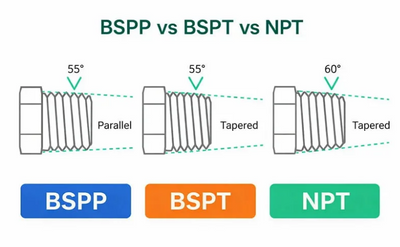
NPT, BSPT, and BSPP pipe connections can look close enough for the wrong parts to begin engaging. They are not one interchangeable family. NPT uses an American 60-degree tapered thread. BSPT uses a British 55-degree tapered Whitworth form. BSPP uses a 55-degree parallel thread and depends on a separate sealing feature defined by the connection.
The risk is greatest during replacement work, when a worn sample has no readable marking. Identification should establish thread form and sealing method before anyone tests compatibility by tightening.
Place each standard on a geometry map
NPT is defined in the general-purpose U.S. pipe-thread standard ASME B1.20.1. Its male and female diameters change along the axis, producing interference as they are assembled. An approved thread sealant normally closes the remaining spiral leakage path.
BSPT is a tapered British Standard Pipe thread associated with ISO 7-1 and related standards. Its thread form is based on a 55-degree Whitworth profile with rounded crest and root geometry. It also creates a pressure-tight joint through tapered engagement under the specified sealing practice.
BSPP is parallel and is associated with ISO 228-1 dimensional threads. The thread itself generally provides retention rather than the primary pressure seal. Depending on the end and port design, sealing may occur at a bonded washer, O-ring, flat face, cone, or another specified interface.
Those standards and sealing arrangements must be confirmed on the actual component drawing. The letters alone do not define the fitting material, working pressure, or seal compound.
Taper is the first field separation
Clean the part and compare thread diameter at two axial locations. A consistent diameter suggests a parallel thread such as BSPP; a changing diameter suggests NPT or BSPT. Use a thread-pitch gauge and calipers, then compare results with authoritative charts.
Next distinguish the 60-degree NPT form from the 55-degree BSP form. Pitch offers useful clues, but some nominal sizes have deceptively close values. A correct profile gauge, port documentation, or verified part number is more reliable than appearance.
Finally, locate the intended seal. A BSPP male may have a shoulder for a bonded seal, an O-ring arrangement, or a cone. A tapered part lacks that parallel-port sealing arrangement. If the connection’s fluid boundary cannot be identified, the part has not been fully identified.
Why approximate compatibility fails
An NPT male forced into BSPT may engage for a few turns, but the angle, pitch, diameter, and crest-root profiles do not create the designed contact. The apparent tightness can come from local thread damage rather than a seal. More torque can permanently damage the port.
BSPP cannot form the normal tapered thread seal of NPT or BSPT. Applying tape to a parallel thread does not create the correct bonded-washer, O-ring, or cone interface. It can also introduce debris into the circuit.
A connection that survives a low-pressure shop check may leak after thermal change, vibration, or pressure cycles. Initial assembly is therefore not an interchangeability test.
Match assembly practice to seal location
For NPT and BSPT, follow the applicable manufacturer procedure for compatible sealant, engagement, and tightening. Keep tape or compound out of the first thread and fluid passage where instructed. Do not transfer an NPT turn-count rule to BSPT.
For BSPP, inspect the specific sealing element and its mating surface. Replace a damaged bonded seal or O-ring with the specified part. A cone-seat connection requires clean, matching metal geometry. The straight thread should start freely and retain the seal without being used as a tapered wedge.
Material changes friction and failure mode. Stainless threads can gall, while a thin or soft female boss may crack or distort under excessive load. Universal torque values detached from the actual component should be avoided.
Use a defined adapter at mixed-standard boundaries
International equipment often combines American and British components. A transition adapter is the controlled solution when it carries a verified NPT end on one side and the correct BSPT or BSPP end and seal on the other.
Specify male/female orientation, nominal size on each side, fitting shape, material, seal type, media, temperature, pressure requirements, and available installation space. Avoid building a long chain of reducers and swivels when one approved adapter can reduce bending load and leak points.
In inventory, keep labels and bins distinct. A thread gauge and a simple inspection record can prevent an NPT part from being returned to a BSP drawer after maintenance.
Document before replacing
Photograph the original port and fitting separately, including the shoulder or internal seat. Record equipment model, visible markings, measured OD, pitch, taper result, seal element, and the opposite connection. If the old part was leaking, do not assume its type was correct merely because it was installed.
NPT, BSPT, and BSPP can all provide reliable service when used with their intended mates. The disciplined approach is to identify taper, profile, pitch, and seal location—then connect different standards only through a part designed to preserve both interfaces.