
NPT Hydraulic Connections: Taper, Sealant, Measurement, and Failure Limits
Jun 7th 2023
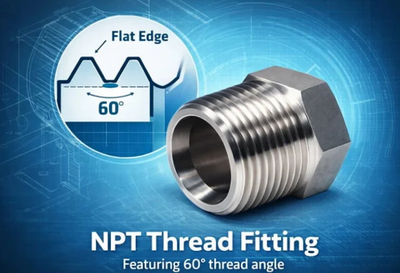
National Pipe Taper remains common in U.S. fluid systems because a threaded fitting can connect directly to a compatible tapered port. Its apparent familiarity is also a source of errors: nominal size is mistaken for measured diameter, sealant is applied without contamination control, and tightening is used to compensate for damaged or mismatched threads.
NPT performance comes from a complete joint. The correct male and female tapers create interference, an approved sealant closes the remaining leakage path, and the component material must tolerate the assembly load and service conditions.
Geometry converts turning into interference
NPT uses a 60-degree thread form and a taper of 1 in 16 on diameter, equivalent to three-quarter inch per foot. ASME B1.20.1 defines the applicable dimensions and gauging. As a male fitting advances into a female port, the increasing diameter produces flank contact and radial load.
That wedging action retains the fitting but does not necessarily create a fluid-tight path by itself. Small crest-root clearances can form a spiral route along the thread. Appropriate pipe compound or tape fills those spaces and also affects installation friction.
Because tightening expands the female component, wall thickness and material matter. An elbow cannot always be turned to any desired orientation, and backing it off can disturb the developed seal.
Nominal pipe size requires conversion
The outside diameter of an NPT male is larger than the nominal pipe size. For identification, clean the part, measure diameter at a defined location, determine threads per inch, and verify taper. Compare the measurements with an authoritative chart rather than matching them to a familiar fraction.
Use a pitch gauge and, where accuracy matters, the specified pipe-thread gauges. Worn, plated, or damaged threads can distort caliper results. A fitting that is close to the chart may instead be BSPT, NPTF, or another standard.
BSPT uses a 55-degree thread form and different pitch and diameter combinations. NPS is straight rather than tapered. SAE straight-thread port connections such as ORB seal with an O-ring and should not receive NPT sealant.
Sealant belongs in the assembly specification
Select tape or compound that is approved for the conveyed fluid, temperature, fitting material, and cleanliness requirements. Follow the product and equipment instructions. Applying tape across the first thread increases the chance that fragments will enter valves and small passages.
Sealant changes friction, so a generic number of turns or torque cannot be transferred across sizes, materials, finishes, and products. Start the joint by hand, keep it aligned, and use the specified installation method. If the fitting binds early, stop and check thread identity and damage.
Stainless tapered threads are prone to galling when friction and contact pressure rise. The authorized compound and procedure may reduce risk, but a seized part should not be forced farther. On softer female components, excessive tightening can permanently expand or crack the port.
Leak patterns identify different causes
Seepage along the thread helix can indicate inadequate or incompatible sealant, insufficient engagement, surface damage, or a wrong standard. A crack around the female boss suggests excessive radial load, thin material, prior damage, or overtightening. A joint that stops in the wrong orientation may have reached its safe engagement limit rather than needing one more turn.
Cross-threading often leaves displaced metal at the entrance and an angled fitting. Galling may show torn or smeared thread surfaces. Corrosion and repeated reuse change how the parts contact. Depressurize before inspection and replace components whose geometry can no longer be verified.
Do not assign a leak automatically to NPT if fluid could have traveled from a nearby hose crimp, adapter, or port. Clean and observe the circuit under its safe test method.
Know where another connection may serve better
NPT can be suitable for compatible stationary ports, utility circuits, air, lubrication, water, and hydraulic components designed around tapered pipe thread. It is widely supported and offers compact direct connection.
Applications requiring frequent disassembly, precise elbow orientation, cleanliness without thread compound, or high resistance to repeated impulse may benefit from a port connection such as ORB or a union style such as ORFS, depending on the design. An adapter can transition standards while preserving the proper seal on both sides.
Thread type alone never supplies a pressure rating. Check the exact fitting, port, material, temperature, media, and equipment limits. Gas service may also be governed by codes and approved components beyond general hydraulic practice.
Preserve identity during maintenance
Record nominal NPT size, male or female end, fitting configuration, material and finish, opposite connection, equipment port, media, and service condition. Store threaded ends capped to protect them from impact and contamination.
During replacement, compare hand-tight engagement and final position with the approved procedure, not with a worn part removed from the machine. If a port has already been over-tightened, installing a new male fitting may not restore it.
NPT is dependable when taper, thread condition, sealant, and component strength are controlled together. Its common appearance should encourage disciplined identification—not make verification optional.