
Specify NPT Fittings by Nominal Size, Taper, Sealant, and Port Strength
HGW Hydraulics on Feb 22nd 2023
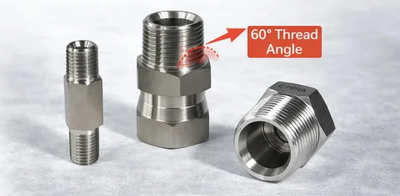
NPT is familiar across U.S. hydraulic, pneumatic, plumbing, instrument, and process equipment, yet it is easy to misidentify because the marked pipe size is not the measured thread diameter. A correct order needs the nominal size, male or female form, material, pressure and temperature capability, and the connection on the opposite end.
Recognize the geometry before reading the size
National Pipe Taper threads use a 60-degree profile and a 1:16 taper on diameter, equivalent to three-quarter inch change per foot. The thread becomes progressively tighter as male and female parts engage. ASME B1.20.1 is a principal dimensional standard for general-purpose NPT threads.
Pitch is stated in threads per inch. Several pipe sizes can share a pitch, so a pitch gauge alone does not identify the connection. Measure the thread at the appropriate location, confirm taper, and compare the result with a recognized chart or gauge. Worn first turns and residual sealant should be accounted for.
Treat nominal pipe size as a name
An NPT size such as 1/8 does not describe a one-eighth-inch outside thread diameter. Pipe sizing developed around nominal bore conventions, while actual thread dimensions are larger. Caliper readings rounded to a common fraction can therefore produce a wrong order.
Record nominal size with the NPT designation. Do not substitute NPTF, BSPT, BSPP, NPSM, or a metric taper because it starts into the port. Thread angle, crest and root form, pitch, taper dimensions, or sealing method can differ.
Seal the helical path under a controlled procedure
Taper interference provides mechanical engagement, but an approved pipe-thread sealant is normally required to close the leakage path along the threads. Select tape or compound for the fluid, temperature, material, cleanliness requirement, and equipment rules. Some services prohibit particular products.
Apply sealant according to its instructions and keep loose material out of the circuit. More sealant cannot correct wrong threads or a cracked port. Lubrication from the sealant also changes tightening behavior, which is one reason a universal torque or turn count should not be invented.
Protect the female component from expansion
Tightening a tapered male fitting creates radial force in the female port. Excess engagement can deform threads or crack a thin boss, valve, instrument, plastic housing, or cast component. Misalignment and cross-threading concentrate that damage.
Follow the component manufacturer’s engagement or torque guidance for the size, material, coating, and sealant. Start the verified combination by hand and stop if resistance appears earlier than expected. When final orientation matters, use a suitable adapter arrangement rather than overtightening an elbow for another turn.
Know when another sealing system is more serviceable
NPT offers broad availability and compact connection options, but repeated disassembly can wear or deform threads. A face seal, flare, O-ring boss, or flange may be more appropriate when the joint is frequently serviced, orientation is critical, or the port must avoid taper expansion.
For a leaking NPT joint, isolate pressure, inspect male and female threads, check for cracks and sealant contamination, and verify the exact standard. If a mismatched fitting was forced into an expensive port, replacing the inexpensive male alone may leave the original damage. Good NPT service depends on correct geometry and controlled assembly, not simply on applying more wrench force.