
NPT or BSP: Identify the Thread Family and Seal Before Replacement
HGW Hydraulics on Jun 28th 2023
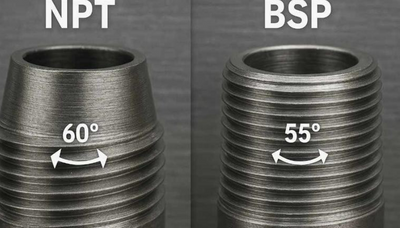
Imported machinery often puts an unfamiliar pipe fitting beside parts stocked for U.S. equipment. NPT and British Standard Pipe connections may appear close, but their thread profiles and sealing arrangements were developed under different standards. A part that turns a few threads is not proof of compatibility.
Replacement begins by splitting “BSP” into BSPP and BSPT. NPT is tapered. BSPT is also tapered but uses a different thread form. BSPP is parallel and normally seals somewhere other than the threads.
Build an identification record before selecting a part
Clean the male and female ends and record whether the thread diameter changes along its length. Determine pitch with a thread gauge and measure diameter with calipers. Inspect the shoulder, port face, cone, O-ring, and washer to locate the intended seal.
NPT uses a 60-degree thread form and a 1:16 taper on diameter under ASME B1.20.1. BSP threads use a 55-degree Whitworth profile. BSPT taper relationships are covered by ISO 7-1 and related standards; BSPP dimensional threads are addressed by ISO 228-1.
Nominal pipe sizes do not equal measured thread OD. At several common sizes the pitch is also close enough to mislead a visual comparison. Use the appropriate profile and pitch gauges and verify against a current chart or component drawing.
NPT puts the sealing task in the tapered joint
An NPT male wedges into a matching NPT female. Thread interference retains the fitting, while an approved tape or compound normally fills the spiral leakage path. Sealant selection and tightening method depend on fluid, temperature, fitting material, port construction, and the manufacturer’s instructions.
Excessive engagement can crack a female boss or gall stainless threads. A tapered elbow may also stop before reaching the desired orientation. These are installation constraints, not evidence that NPT is inherently suitable only for a particular pressure range.
BSP has two different sealing paths
BSPT also uses tapered engagement, commonly with the specified sealing practice. Its 55-degree profile and pitch/diameter combinations prevent a controlled NPT match even when the parts seem to start.
BSPP stays parallel. Its threads provide retention, while a bonded washer, O-ring, flat face, cone, or other designed feature contains the fluid. Applying pipe tape to a BSPP thread does not create the missing face seal.
The male and female design must be checked together. A “G” callout commonly denotes a BSPP thread, while “R,” “Rc,” or “Rp” callouts carry specific meanings under applicable BSP/ISO conventions. Confirm the full drawing rather than translating every label to the word BSP.
Region is a clue, not an inspection method
NPT is common on equipment designed in the United States and Canada. BSP connections are widespread on European, Asian, Australian, Middle Eastern, and globally supplied machinery. Modern assemblies can mix regions through adapters or OEM-selected components.
Country of origin helps establish candidates but cannot identify the installed end. A U.S. power unit may contain a BSPP valve, and an imported machine may have an NPT accessory. The equipment manual, port marking, and measurements take precedence.
A false fit creates delayed failures
Forcing NPT into BSPT produces incomplete flank contact because the included angles and often the pitches differ. Local metal deformation can feel like normal tightening. The resulting gaps may leak immediately or after vibration, temperature change, or pressure cycling.
Trying to wedge NPT or BSPT into a BSPP port can damage the straight thread and the face where the real seal belongs. Additional sealant may temporarily hide seepage but cannot correct geometry. Damaged ports may then reject the proper fitting as well.
If the standards must meet, use a purpose-designed transition adapter with the verified seal on each side. Specify male/female orientation, nominal size, body shape, material, media, and service conditions. Avoid long adapter stacks that increase leverage and leak points.
Protect future replacements
Label bins and hose assemblies with the complete connection designation. Store capped parts separately and retain drawings or supplier dimensional data. During receiving, inspect thread form and sealing features rather than accepting a broad description such as “half-inch pipe.”
NPT and BSP selection is not a contest between regions. It is a geometry and sealing decision. Identifying taper, pitch, profile, and fluid boundary before ordering prevents the damage created by an approximate match.